My grandmother came to America after the Second World War with her Catholic faith largely intact and almost nothing else. There were no photographs from Poland – nothing to put on a wall, nothing to point to and say this is where we are from. That absence was its own kind of information. I grew up understanding that being Polish was inseparable from loss, from resistance, from a faith that had functioned less as personal spirituality than as an act of national survival – and understanding it, in large part, through what was missing rather than what remained. It took me years to articulate what that meant. It took Behemoth to make me feel the argument on the other side with anything like equivalent force.
That is what Polish extreme metal does when it is doing its job. It is not a genre exercise. It is not Scandinavian influence filtered through a Slavic accent. It is a living argument about what Poland is, what it owes its dead, and what it is permitted to become.
I. The Weight of the Soil
To understand why Polish extreme metal carries a cultural charge that has no real equivalent in, say, Swedish death metal or Norwegian black metal, you have to understand what Poland is – and what it has been made to be.
Between 1772 and 1795, Poland ceased to exist as a nation. In three successive partitions, the Russian Empire, Prussia, and Austria divided the country entirely, erasing it from the map of Europe for over a century. What survived Polish national identity during that period was, in no small part, the Catholic Church. When the state was gone, the Church remained – not merely as a religious institution but as cultural archive, as keeper of language, as organizational spine of resistance. That fusion of Catholic faith and Polish nationhood is not a metaphor. It is a structural fact of Polish history, one that the Communist regime attempted to suppress and failed, one that Solidarity exploited against Soviet authority, one that the political right has weaponized throughout the twenty-first century.
This is the context into which Polish extreme metal was born. To play black metal or death metal in Poland is not a culturally neutral act. In Norway, the church burnings of the early 1990s were a transgression against an institution most Norwegians regarded with polite indifference. In Poland, the same gesture lands differently – it lands against something that a significant portion of the population does not experience as mere organized religion but as the vessel of national identity itself. The stakes are not equivalent. The weight is not the same.
The scene did not emerge in a vacuum, either. Vader‘s Peter Wiwczarek was building the foundations of Polish death metal in Olsztyn by 1983, long before the Soviet bloc collapsed, in a country where extreme metal was not simply a youth subculture but a quiet act of cultural resistance. The Poland that produced Vader was a different country than the one that would later watch Adam Darski stand trial for blasphemy – but the continuity between those two moments is exactly what makes Polish metal worth examining as a scene rather than a collection of bands.
II. The Confrontationalists: Behemoth and Hate
No figure in Polish metal carries the cultural weight of Nergal – Adam Darski, guitarist and vocalist of Behemoth — and the arc of his career reads less like a musician’s biography than like a cultural thermometer measuring Poland’s internal temperature over three decades.
Behemoth began in 1991 as a relatively orthodox black metal outfit out of Gdańsk, operating in the shadow of the Scandinavian template. By Satanica (1999), they had pivoted sharply toward blackened death metal, and by Demigod (2004), they had refined that pivot into something genuinely lethal: technically precise, ritualistically conceived, and ideologically unambiguous in its anti-Christian posture. The Satanist (2014) remains the apex of that project – an album that functions not as shock-value provocation but as a coherent occult argument delivered through some of the most controlled and ferocious extreme metal of the decade. The juxtaposition of “Ora Pro Nobis Lucifer” – Latin liturgical phrasing inverted into Satanic supplication – with Poland’s dominant religious culture is not accidental. It is the point.
The blasphemy cases make this explicit – and the plural matters. In 2007, during a concert in Gdynia, Nergal tore pages from a Bible and called the Catholic Church “the most murderous cult on the planet.” A Polish Catholic organization filed criminal charges under Article 196 of the Polish Penal Code, which criminalizes offenses against religious feelings and carries a potential two-year prison sentence. A Warsaw court acquitted him in 2010; a higher court in Gdańsk overturned that ruling in 2012 and sent the case back down. The saga dragged on for years. That was only the first case.
A second charge followed from a 2019 Facebook post in which Nergal was photographed stepping on an image of the Virgin Mary during a Me and That Man photo shoot. He was convicted and ordered to pay fines totaling roughly $5,000 USD, contested the ruling, and ultimately won his appeal – the case was dismissed in September 2021. A third case arose from a 2018 social media video in which he sang a children’s song for International Women’s Day while displaying a phallic crucifix sculpture – a gift, for what it’s worth, from Celtic Frost‘s Tom G. Warrior. Two charges in that case ended in acquittal in early 2025; a third was conditionally dropped. As of mid-2026, Nergal has no active blasphemy proceedings pending. He has won or had dismissed every case brought against him.
Read that pattern carefully. The Polish state – operating within a legal framework shaped by the Church’s cultural authority – repeatedly brought charges against the same musician across nearly two decades, and repeatedly lost. Nergal released The Shit Ov God in 2025 and is currently touring North America on a run called The Godless IV. The institution kept swinging. The institution kept missing. And the argument Behemoth has been making since Evangelion (2009) kept getting louder with each failed prosecution. Polish society split along recognizable fault lines at every turn – the Church’s supporters saw desecration; the secular and younger generation saw exactly the institutional overreach the band had always named. Nergal became a symbol before the first verdict was rendered, and the subsequent decade and a half of failed prosecutions only calcified that status. Symbols don’t require acquittal to function. But it doesn’t hurt.
Hate occupy a similar ideological territory but operate in Behemoth‘s shadow in a way that undersells them. Founded in Warsaw in 1990, they have built a catalog as consistent as it is underappreciated outside underground circles. Bellum Regiis, released May 2, 2025 via Metal Blade, arrives as their most recent statement – and their most politically direct. Where Behemoth‘s anti-Christian posture is rooted in occult philosophy, Hate‘s work on Bellum Regiis draws more explicitly on pre-Christian Slavic mythology and the concept of an older Poland, one that predates the Roman Church’s arrival in 966 CE under Prince Mieszko I. The album’s title – War of Kings – gestures toward a historical imaginary in which the Church’s dominion over Polish identity is a colonial imposition rather than an inheritance.
III. The Mythologists: Mgła, Furia, Batushka
If Behemoth and Hate are confrontationalists – bands that engage the Church directly and refuse to let the audience look away — then Mgła, Furia, and Batushka represent a different mode: the construction of an alternative identity rather than the dismantling of an existing one.
Mgła are, by any serious measure, the most significant atmospheric black metal band to emerge from Poland and one of the most significant of the past two decades globally. Based in Kraków, their members – Mikołaj “M.” Żentara and Maciej “Darkside” Kowalski — kept their identities anonymous through much of the band’s early period, a choice that was never a gimmick but a philosophical position: the work should speak without the interference of personality, biography, or cultural assignation. That the names are now in the public record does not dissolve the posture – the music still refuses to invite biographical reading. Exercises in Futility (2015) is their landmark – six untitled tracks designated by Roman numeral, each an extended meditation on futility, on human pretension, on the particular exhaustion of consciousness. It is black metal as philosophical argument, and it is made in Poland, which means the futility it meditates on resonates against a specific cultural backdrop whether Mgła intend it to or not.
This is the tension at the center of their project. When you record black metal about meaninglessness in a country where meaning – national, religious, historical – has been fought over for centuries, the music does not exist in a vacuum. Exercises in Futility VI, the closing track, runs nearly eleven minutes of circling, unresolved melodic lines over blastbeats that never arrive at catharsis. In a Scandinavian context, that reads as misanthropic aestheticism. In a Polish context, it reads as something more specific, even if the band would refuse the reading. The refusal is itself a position.
Furia complicate the picture further, and in the most interesting way. Where Mgła reach for universality through anonymity, Furia reach for specificity through language – their lyrics are in Polish, not English or Latin or any lingua franca of extreme metal, and the decision carries weight. To sing in Polish is to refuse the internationalization that allows metal to travel frictionlessly across cultural borders. It is to insist on the local. Their sound, rooted in atmospheric and avant-garde black metal with elements that have been described as drawing on Polish folk tradition, makes the same insistence sonically. This is music that sounds like it comes from somewhere, and that somewhere is specific. Furia are confirmed for Hells Bells Szczecin in June 2026, and their presence on that bill alongside acts from across the European extreme underground is itself a kind of argument: this is not a regional curiosity. This is a scene with something to say.
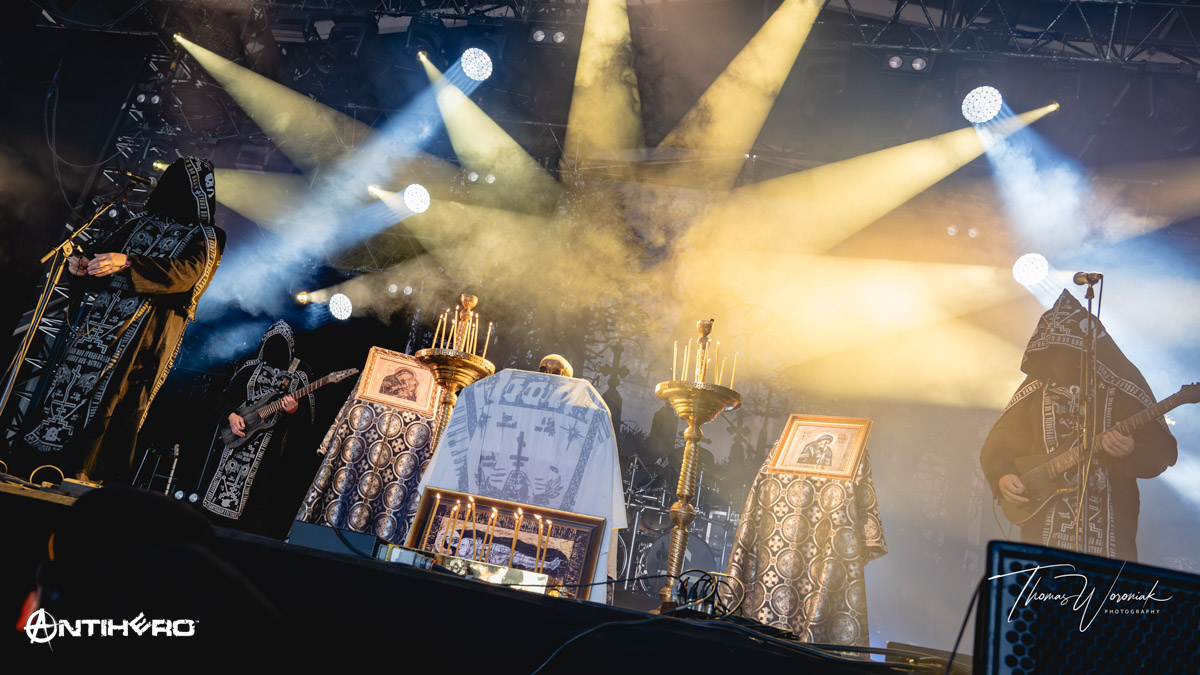
Batushka require careful handling. The well-documented split between factions – following the internal conflict that generated competing claims to the name – is a story better told in legal briefs than in music criticism. What matters here is Litourgiya (2015): Orthodox liturgical chant and ceremony absorbed into black metal, made by Poles engaging with Eastern Orthodox aesthetics rather than the Roman Catholic framework that dominates Polish religious life. The songs were sung in Old Church Slavonic – a liturgical language that vocalist Krysiuk did not actually speak, which only deepens the point. The alienness of the choice is part of the argument. To reach east toward Orthodoxy rather than west toward Rome is to reject the specific form of Christianity that fused with Polish nationalism, and to do so in a language that is itself a kind of deliberate estrangement – familiar enough in its Slavic roots to carry weight, foreign enough to refuse domestication. It is its own kind of argument.
IV. The Technicians: Vader and Azarath
Not every band in the Polish extreme metal scene is primarily engaged in cultural argument. Vader have never been a conceptual band in the way Behemoth or Mgła are. What they have been, since Peter Wiwczarek co-founded the band in Olsztyn in 1983 — initially as bassist, before taking on guitar and vocal duties – is evidence that Poland could produce extreme metal that competed on purely musical terms with anything being made anywhere. Their 1992 debut The Ultimate Incantation announced the intent; De Profundis (1995) delivered on it, cementing their status as one of the most technically precise and relentlessly consistent death metal acts in the world.
Peter Wiwczarek is the sole consistent member across four-plus decades and a catalog of twelve studio albums, and the argument his longevity makes is straightforward: Polish extreme metal did not need Scandinavian scaffolding. It was building something of its own from the start. Tibi et Igni (2014) remains a career highlight – a record that demonstrates what death metal sounds like when a band has spent thirty years drilling toward the center of what they do.
Azarath are worth mentioning specifically because of the Inferno connection – Behemoth‘s drummer, one of the most technically accomplished in extreme metal, is the driving force behind Azarath‘s sound. The band’s blackened death metal operates at the extreme end of technical precision, and their existence as a side project of key Behemoth personnel speaks to the density of the Polish underground: it is small enough that key figures circulate through multiple projects, large enough to sustain a genuine scene.
V. The Fault Lines
No honest account of the Polish extreme metal scene can avoid the nationalism problem.
Slavic pre-Christian identity – the Rodnovery movement, the reconstruction of pre-Christian Slavic religion and mythology – has been a genuine cultural and spiritual framework for some musicians in Poland and across Eastern Europe. For Furia, for aspects of Batushka‘s aesthetic, for bands throughout the Slavic black metal orbit, the appeal is comprehensible: it offers an identity that is culturally specific without being entangled in the Church-state fusion that defines mainstream Polish national identity. It is an exit from a particular argument.
But Slavic identity metal has also been co-opted. In some corners of the Eastern European black metal underground, pre-Christian Slavic identity has drifted into ethnic nationalism, into a mythology of blood and soil that has nothing to do with spirituality and everything to do with racial exclusion. The scene is not monolithic here, and the lines are not always clean. To celebrate pre-Christian Slavic culture is not, in itself, a political statement. To weaponize it in the service of ethnic nationalism is something else entirely, and writers covering this scene have an obligation to distinguish between the two rather than either flattening everything into fascism-adjacency or refusing to acknowledge that the problem exists.
Mgła‘s sustained refusal to be recruited into any cultural narrative – including the narrative of Polish metal as political statement – is, in this context, not avoidance but intellectual integrity. They make music. They refuse to let it become a flag. That refusal has not stopped listeners from finding meaning in the music that exceeds what the band will authorize, but that is the nature of art that operates at genuine depth.
The generational dimension is also shifting. The years of PiS (Law and Justice) dominance from 2015 to 2023, with their Catholic-nationalist cultural agenda, produced a specific cultural climate in which extreme metal’s anti-Church positioning carried additional political resonance for younger Polish audiences – not because the bands changed, but because the backdrop against which they were heard intensified. Post-electoral shift or not, the Church’s institutional position in Polish life has not transformed overnight. The argument the music is making is not finished.
VI. What Poland Hears That We Don’t
There is a version of this story that Western listeners tell themselves, usually unconsciously: Polish metal is “European extreme metal,” distinguishable from Scandinavian output primarily by geography and perhaps a certain Slavic grimness of temperament. That story is wrong, and it is wrong in a way that matters.
When Nergal tears a Bible apart on a Polish stage, he is not doing what Venom or Slayer did – reaching for transgression as aesthetic. He is engaging a specific institution that, in Poland, has the cultural function of a second government. When Mgła records six tracks meditating on futility in a country where an entire generation was asked to build meaning on the ruins of communist suppression and the promises of rapid Westernization, the futility is not abstracted. When Furia sings in Polish, they are insisting on the weight of a language that was itself suppressed under partition – that was a form of resistance simply by being spoken.
Polish identity has been built and erased and rebuilt so many times that the question of what it actually is, at its core, remains genuinely unresolved — and genuinely contested. My grandmother carried that unresolved question across an ocean and never had anything physical to show for what came before. Polish extreme metal is one place where that contest happens, with real stakes, at real volume.
You can hear The Satanist and appreciate its construction without understanding any of this. But you cannot fully understand what Behemoth built, or why it matters in Poland the way it does, without reckoning with what Nergal was actually arguing and who he was arguing with. The music was always the argument. We in the West have just been listening to the sound.
Krew i pył — blood and dust. The formula of what remains after everything else is taken. My grandmother had no photographs to leave behind, nothing to document what was lost. Polish extreme metal has spent forty years documenting exactly that loss, in the only language available to it. It is time the rest of the world understood what it’s been hearing.
“Forty years of blood and dust. What took us so long to listen?”