Seven years is a long time to go quiet. For a band with Hecate Enthroned‘s lineage — architects of the orchestral British black metal movement, a group whose 1997 debut The Slaughter of Innocence, A Requiem for the Mighty helped define what symphonic extremity could sound like in the UK underground — the silence since 2019’s Embrace of the Godless Aeon has been conspicuous. The Corpse of a Titan, A Lament Long Buried, their sixth full-length, answers with something worthy of the wait: a dense, deliberate, and atmospherically rich record that demands patience and rewards it in roughly equal measure.
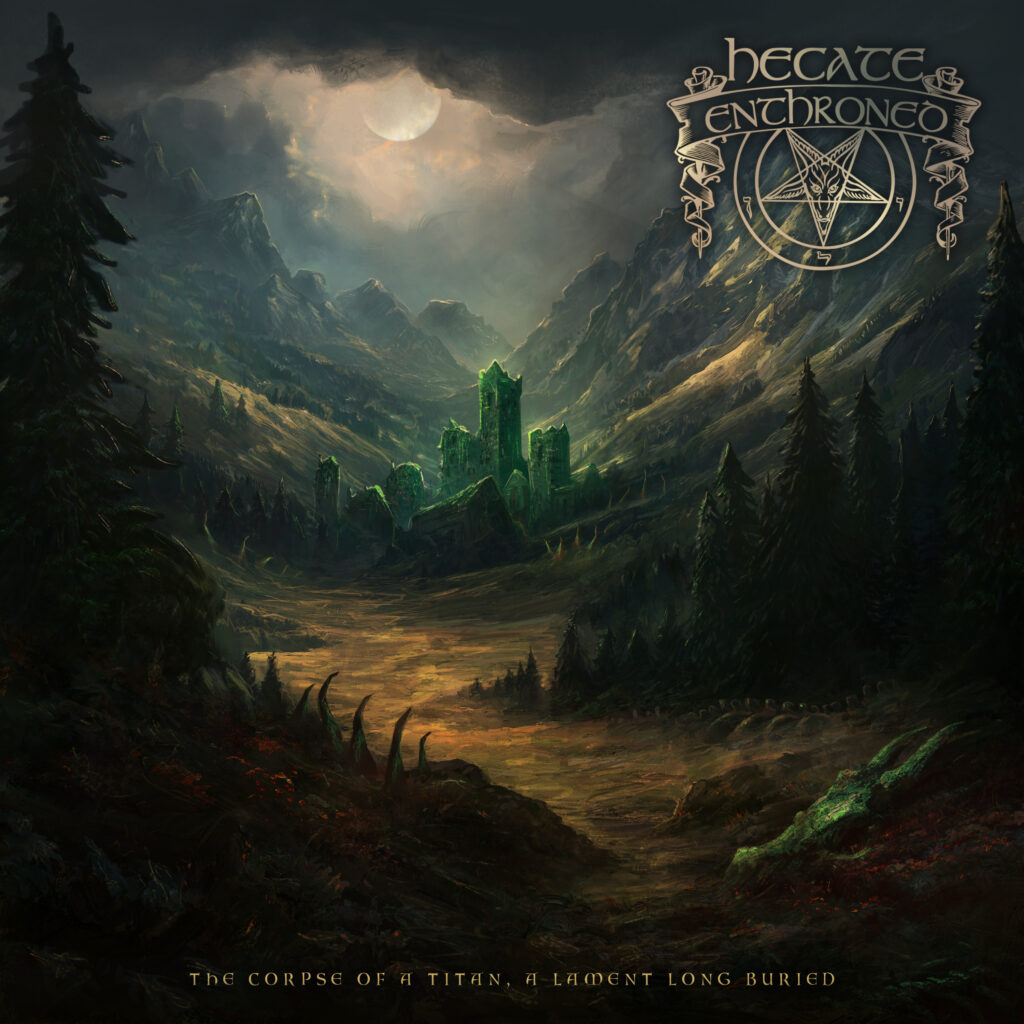
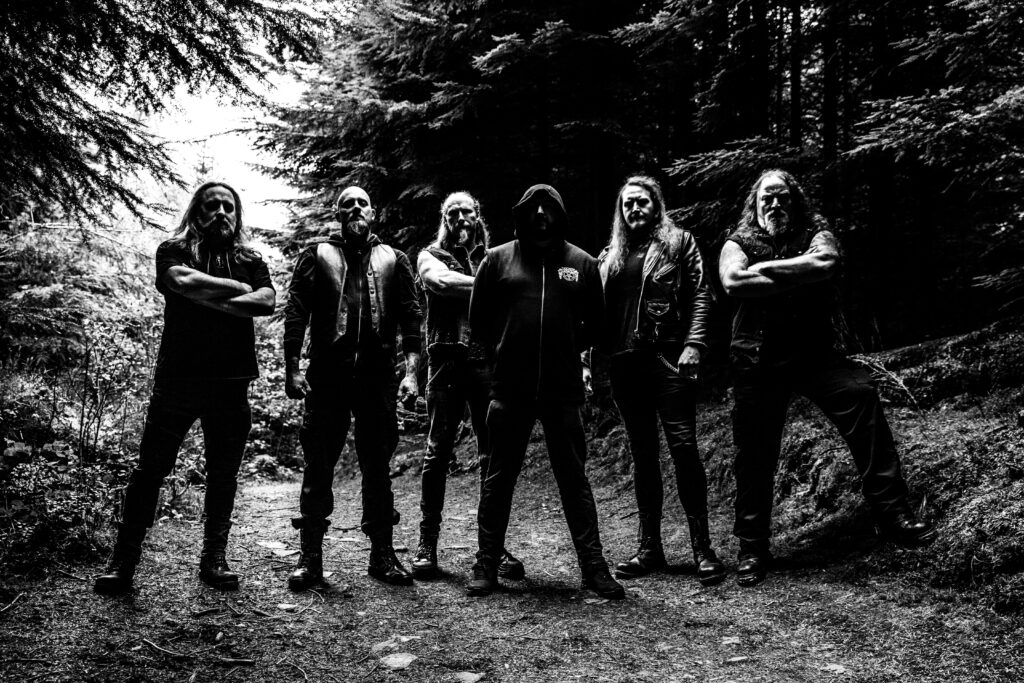
Hecate Enthroned have never been a band easily summarized. Their catalog traces a line from the raw, Andy Sneap-produced aggression of their Blackend Records era through the more refined approach that characterized Embrace of the Godless Aeon — their first album with vocalist Joe Stamps and their M-Theory Audio debut. The Corpse of a Titan sits closer to the latter in sonic polish while reaching further back in spirit, drawing its thematic material from ancient British myth and Celtic folklore.
The thematic architecture of The Corpse of a Titan draws from the Mabinogion, the medieval Welsh collection of myth and legend that represents one of the earliest bodies of prose literature in Britain, and the album is richer for it. “Adar Rhiannon” takes its name from the Birds of Rhiannon, three supernatural birds whose song is said to be so beautiful it can wake the dead and send the living into an enchanted sleep that lasts seven years. As an opening instrumental, the choice is not incidental: it positions everything that follows as something heard in that liminal state, suspended between waking and oblivion. “Pwca” draws on the Welsh trickster spirit — a shapeshifting creature of uncertain intent, neither wholly malevolent nor benign, associated with leading travelers astray in the dark. That the band renders it as a guitar, strings, and piano instrumental ballad rather than a blast-driven set piece is a quietly intelligent decision: the Pwca doesn’t announce itself. It unsettles you gently. “Steed of the Still Water” likely references the Ceffyl Dŵr, the Welsh water horse of folklore — a spectral equine figure that emerges from lakes and rivers, beautiful and dangerous. Against that context, the track’s hypnotic, measured rhythm section reads as something more than a pacing device; it mirrors the creature’s deceptive stillness.
What this mythological framework gives the album is a coherent emotional logic. These are not random invocations of Celtic imagery for atmospheric effect. The Mabinogion is a literature of transformation, loss, and the persistence of the ancient world into the present, which maps directly onto an album titled The Corpse of a Titan, A Lament Long Buried. Bassist Dylan Hughes has described the record as “lyrically based around ancient British myths and legends,” and that grounding is audible in the album’s pacing and tonal decisions. The grief here is old grief. The kind that doesn’t resolve.
Production duties fall to the band and Dan Abela, whose résumé includes work with Akercocke, Bleed From Within, and Anaal Nathrakh — engineers well acquainted with the precise calibration required to make extreme music feel both ferocious and controlled. The mix achieves what it needs to: the symphonic architecture has genuine weight, the guitars and bass lock into a dense, distorted wall without smearing the finer details, and the orchestration doesn’t overwhelm the compositions so much as inhabit them. What Abela and the band have built here is a record that sounds like it was made by people who understand that atmosphere is architecture.
The album opens with “Adar Rhiannon,” a 43-second instrumental that functions as a ritual threshold — austere, foreboding, measured. It establishes the tonal register without overplaying its hand. “Spirits Stir Within Our Ancestors Tombs” follows, and it is here that Stamps asserts himself with a vocal ferocity that sets the pace: slow, deliberate, tension coiled beneath the surface before the double kick and distorted wall of guitars erupt. Acoustic passages offer temporary relief mid-track — a structural device the band returns to throughout the record to prevent the density from becoming monotonous.
“Steed of the Still Water” is one of the album’s more important moments, not for any single dramatic gesture but for what it does to the record’s pacing. The acoustic guitar opening provides continuity and a sense of narrative pull, while the rhythm section leans into something more hypnotic than the blast-driven passages surrounding it. It acts as a counterweight, steadying the album’s momentum precisely when it needs it. “Pwca,” a six-minute instrumental built around the interplay of violin and piano, achieves something rarer: genuine emotional weight. It is the most unguarded the band gets here, and it works as a direct contrast to the visceral fury surrounding it.
“Deathless in the Dryad Glade” is the album’s high-water mark. The track opens in something approaching funeral doom territory — the silence between each arpeggio strike carries as much tension as the notes themselves — before releasing into a cathartic blast beat-driven passage that earns every second of the buildup. The closer, “Into a Vale of Endless Snow,” reopens the album’s eyes after the fatigue of the middle stretch: a dissonant orchestral passage at its core that registers as genuinely unexpected, functioning as a compositional statement rather than a transitional device, before the dynamics settle into a tranquil ambient resolution.
That middle stretch, however, is worth addressing honestly. By the forty-minute mark, the weight of consistently seven-minute compositions begins to accumulate. “The Boreal Monastery” is the weakest link — it asks for full investment while offering little that hasn’t already been established elsewhere on the record. There is also a persistent issue with Stamps’ vocals: as fierce and commanding as his delivery is, the high-pitched distortion of the mix swallows the lyrical content whole. For a band working within an explicitly mythological and narrative framework, losing the words is a genuine loss. The concept deserves to be heard, not just felt.
These are real friction points on a record that otherwise demonstrates what Hecate Enthroned are capable of when given the time to build something with intention.
Seven years between records asks a lot of any audience. The Corpse of a Titan, A Lament Long Buried makes a credible case that it was time well spent — and serves as a pointed reminder that when the conversation turns to British black metal’s finest, Hecate Enthroned belong in it. Hecate Enthroned have spent seven years building a monument to ancient grief. It shows — and on the evidence here, that is very much a compliment.
Tracklist:
| Title | Duration |
|---|---|
| Adar Rhiannon | 0:43 |
| Spirits Stir Within Our Ancestors Tombs | 8:11 |
| The Arcane Golem | 6:14 |
| Steed of the Still Water | 7:10 |
| Pwca | 6:08 |
| Deathless in the Dryad Glade | 6:37 |
| A Gallery of Rotting Portraits | 4:41 |
| The Boreal Monastery | 7:03 |
| Into a Vale of Endless Snow | 7:10 |
Social Links: Facebook | Instagram | Bandcamp | Spotify | Apple Music
Review
Overall - 8
8
Seven years between records is a significant ask of any audience. On The Corpse of a Titan, A Lament Long Buried, Hecate Enthroned justify the wait with their most mythologically grounded and atmospherically ambitious work to date — drawing from the Mabinogion and the Welsh folkloric tradition to build a record with genuine conceptual cohesion. The runtime demands real commitment, and not every moment earns its length. But the peaks are real, and so is the reminder that Hecate Enthroned belong in the conversation when British black metal's finest are being named.