Waiting is rarely part of metal’s vocabulary, but Dimmu Borgir have never moved on anyone’s schedule but their own. Eight years separate Grand Serpent Rising from Eonian — long enough for trends to cycle twice, for rivals to dissolve and reform, for the band’s own lineup to shift. In 2024, guitarist Galder departed after a quarter century to return his focus to Old Man’s Child, dissolving the three-headed creative partnership of Shagrath, Silenoz, and Galder that defined Dimmu Borgir’s imperial era. Lesser bands calcify under that kind of pressure. Dimmu Borgir made arguably their finest record.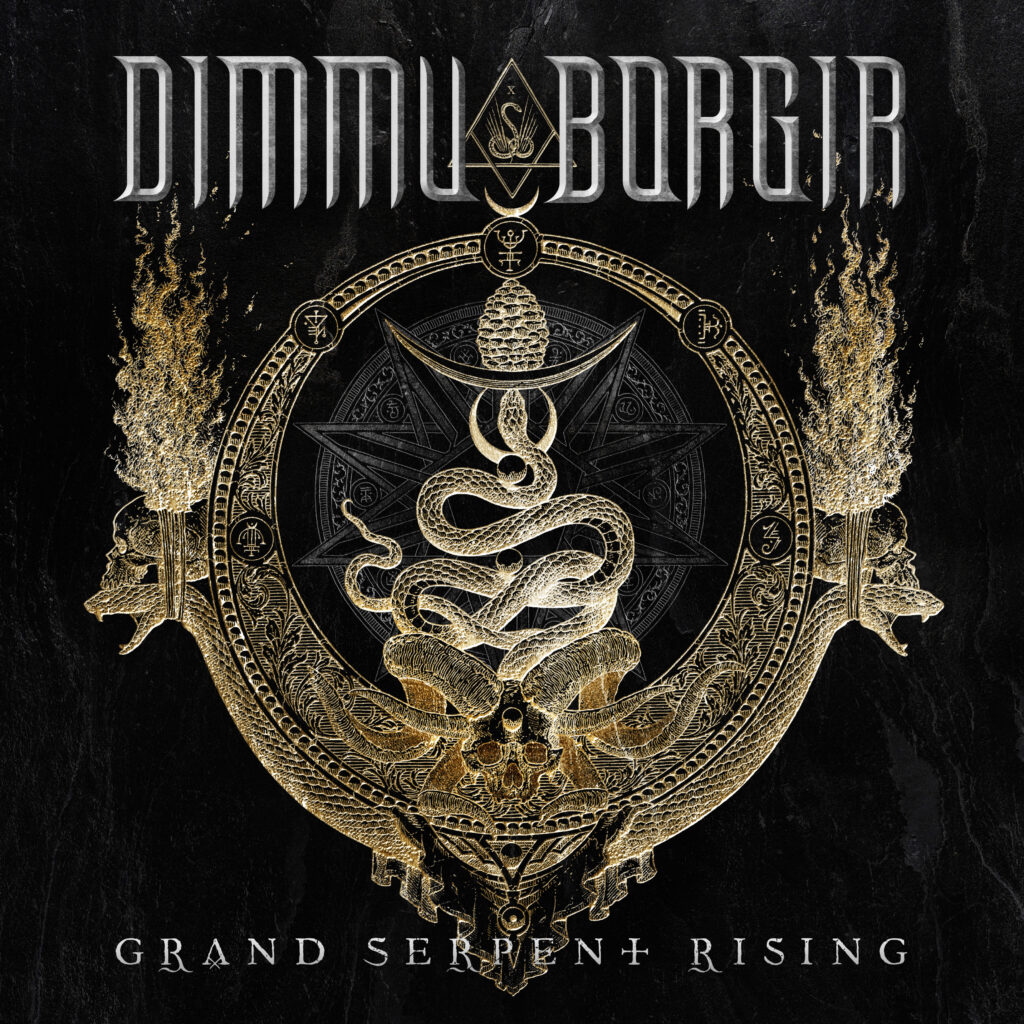
That claim deserves scrutiny, so here is the evidence: since forming amid Norway’s second-wave black metal moment in 1993, Shagrath and Silenoz have spent three decades refining a sound that exists somewhere between the acrimony of Gorgoroth and the orchestral grandeur of Nightwish, threading the needle between genuine blackened menace and widescreen theatricality with a sophistication that most of their contemporaries only approximate. Puritanical Euphoric Misanthropia (2001) established the formula; Death Cult Armageddon (2003) expanded it with full orchestral integration; Eonian (2018) showed the seams, its orchestrations sometimes sitting atop the guitars rather than inside them. Grand Serpent Rising addresses that imbalance directly and with authority.
Conceptually, the album traces an esoteric arc — the Kundalini, or Serpent Fire, the ascending spiritual current rooted in Hindu tantric tradition that is said to awaken dormant divine centers within the practitioner, transforming the seeker across lifetimes. For Dimmu Borgir, who have always operated at the intersection of occult aesthetics and genuine philosophical inquiry, this is native territory. The serpent of the title is not a horror image; it’s a symbol of renewal and gnosis — shedding skin, ascending, transcending the mortal condition. The thematic coherence never hardens into a rigid concept-album structure, but the thread runs through the record’s thirteen tracks, giving Grand Serpent Rising a gravitational center that Eonian lacked.
That coherence extends to the production. Working once again with Fredrik Nordström — the Gothenburg producer behind both Puritanical Euphoric Misanthropia and Death Cult Armageddon — Dimmu Borgir have achieved something genuinely difficult: a symphonic black metal record that sounds organic. The stated goal was to capture the band as a live unit, and the result bears it out. The orchestrations and keyboards, handled by Gerlioz, no longer float above the instrumentation like a separate layer of lacquer; they are woven into the arrangements deliberately, appearing where they add mass and receding when they would crowd the riff. The decision to scale back the choirs is the right one — their absence is felt as tension, and their entry on tracks like “Repository of Divine Transmutation” hits with corresponding weight. Daray’s drum work deserves particular attention: where Eonian buried the kit in a processed morass, the natural timbre and resonance of the drumheads are audible on Grand Serpent Rising, lending a dimensionality that gives the rhythm section actual presence in the mix.
The guitars — shared between Silenoz and guest guitarist Kjell ‘Damage’ Karlsen of Chrome Division — hold the record together. Karlsen is not Galder, but his contributions are judicious where they need to be and ferocious where the song demands it. The intro to “Repository of Divine Transmutation” immediately establishes his command of Dimmu Borgir’s melodic vocabulary, and his solo in “Ascent” — the opening proper after the brief orchestral overture “Tridentium” — sets the record’s tone with precision: aggressive and technically assured, but never indulgent. Silenoz and Karlsen trem-pick with purpose, and the crystalline clean passages in “As Seen in the Unseen” provide relief from the album’s sustained intensity without releasing its tension. Shagrath, meanwhile, deploys his characteristically less abrasive vocal palette — a baritone croak that slides into melody — with the assurance of a vocalist who knows exactly where his instrument lives in the frequency range. On “Slik Minnes en Alkymist,” one of two tracks recorded in Norwegian, that instinct feels particularly well-calibrated, the native language giving the melodic phrasing an extra weight that English would have softened.
“As Seen in the Unseen” and “The Qryptfarer” are the album’s twin peaks. The former threads razor-sharp melodic hooks through an atmosphere of coiling, decorative austerity — it is the record’s most immediate track and also one of its most intricate. The latter resounds with the kind of unhurried confidence that comes from a band who genuinely know what they’re doing: the interplay between the orchestration and the riff is as precisely calibrated as anything Dimmu Borgir have written. Both tracks demonstrate how thoroughly Silenoz and Shagrath have absorbed the lesson of Eonian‘s shortcomings and corrected course.
At sixty-nine minutes across thirteen tracks, Grand Serpent Rising is a substantial commitment. The back half tests that commitment in ways the front half does not: “Shadows of a Thousand Perceptions” and “Recognizant” are competent but don’t hit with the force of the record’s strongest material, and the closer “Gjol” — a reference to the Norse mythological river that separates the living from the dead — resolves the album’s spiritual arc with an atmospheric restraint that is conceptually fitting but may leave some listeners reaching for a more cathartic endpoint. Whether that restraint is a sequencing misstep or a deliberate tonal choice is a question that repeated listens haven’t fully resolved.
What is not in question is the accomplishment: Grand Serpent Rising is the most fully realized record Dimmu Borgir have made since Death Cult Armageddon, and the first time in two decades that the band’s symphonic ambitions and their black metal instincts have been in genuine equilibrium.
The Serpent has shed its skin. What emerges is the most dangerous Dimmu Borgir in twenty years.
Grand Serpent Rising track listing
| No. | Title | Length |
|---|---|---|
| 1. | “Tridentium” | 3:55 |
| 2. | “Ascent” | 5:21 |
| 3. | “As Seen in the Unseen” | 6:59 |
| 4. | “The Qryptfarer” | 4:30 |
| 5. | “Ulvgjeld & Blodsodel” | 5:42 |
| 6. | “Repository of Divine Transmutation” | 6:33 |
| 7. | “Slik Minnes en Alkymist” | 5:38 |
| 8. | “Phantom of the Nemesis” | 5:07 |
| 9. | “The Exonerated” | 5:57 |
| 10. | “Recognizant” | 5:51 |
| 11. | “At the Precipice of Convergence” | 4:16 |
| 12. | “Shadows of a Thousand Perceptions” | 5:29 |
| 13. | “Gjoᶅl” | 4:00 |
Total length: 69:18
Review
Overall - 8
8
Eight years removed from Eonian and reconfigured after Galder's 2024 departure, Dimmu Borgir return with Grand Serpent Rising, their tenth studio album and arguably their strongest work since Death Cult Armageddon. Produced once again by Fredrik Nordström, the record achieves a long-sought equilibrium between the band's symphonic ambitions and their black metal instincts — orchestrations woven into the arrangements rather than layered over them, Daray's drums given genuine presence in the mix, and Silenoz and guest guitarist Kjell 'Damage' Karlsen holding the riff work to a standard that never lets the orchestral elements carry the weight alone. Thematically, the album traces an esoteric arc drawn from Kundalini tradition — the ascending Serpent Fire as a metaphor for transformation and gnosis — giving thirteen tracks a coherence that Eonian lacked. Highlights "As Seen in the Unseen" and "The Qryptfarer" represent the band at their most precisely calibrated, while the Norwegian-language "Slik Minnes en Alkymist" demonstrates Shagrath's melodic instincts at their most assured. The back half tests the album's considerable runtime, and the atmospheric closer "Gjol" may leave some listeners wanting a more cathartic resolution, but these are minor reservations against a record that proves Shagrath and Silenoz remain the definitive architects of symphonic black metal's upper tier.