Seeing Rory Gallagher at Belfast’s Ulster Hall was a rite of passage for a young rock fan growing up in Northern Ireland, and it was one of the very first gigs I ever went to. So when I got the chance to talk with his brother Donal, who was at Rory’s side through three decades on the road, it felt like a conversation I’d been waiting years to have.
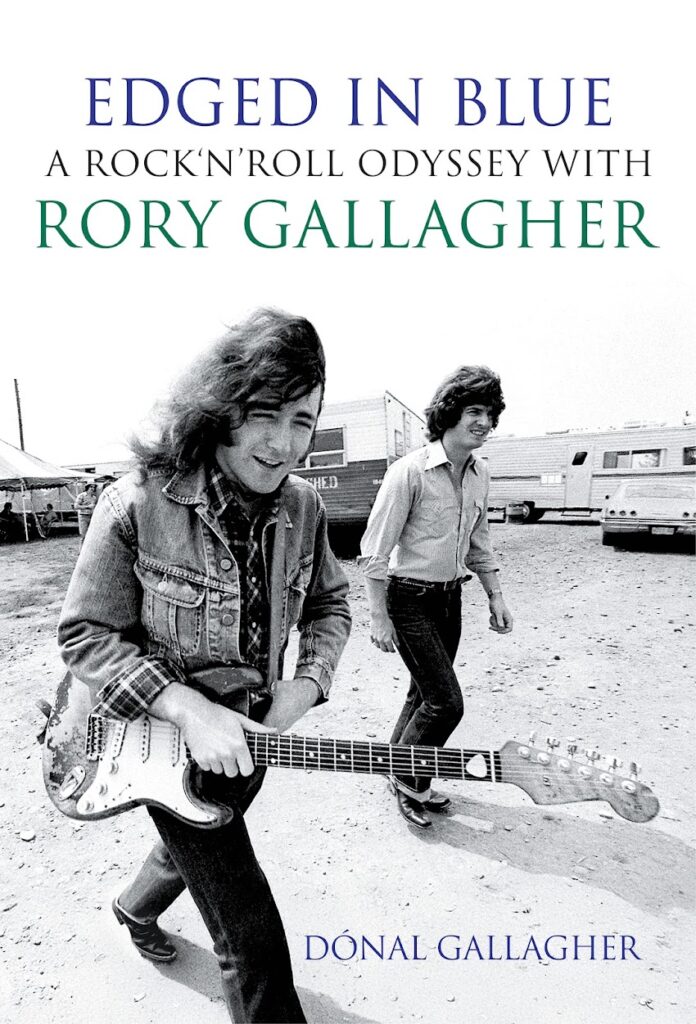
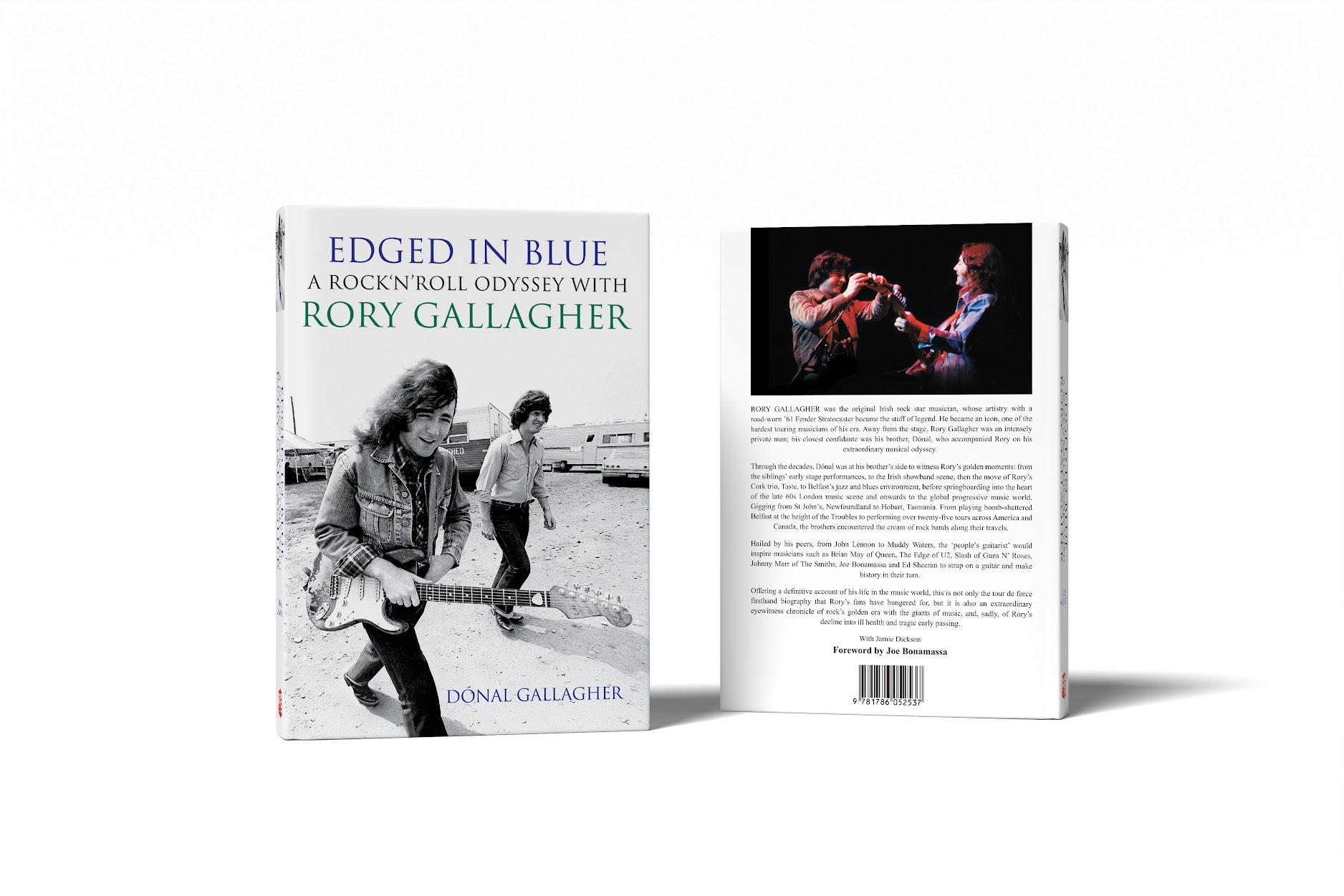
Thirty years after Rory’s death, Donal has finally told the story in his own words. Edged in Blue: A Rock’n’Roll Odyssey with Rory Gallagher, which carries a foreword by Joe Bonamassa, follows Rory from Ireland’s showband circuit to stages around the world. Along the way, it covers a Belfast scarred by bombings, a tour run that reached as far as Tasmania, and more than two dozen trips across North America. The road stories are as wild as you’d hope. At one show Donal had to get out of the way of a charging bull, and at another he pushed through a riot, tear gas, and flames to rescue Rory’s battered ‘61 Stratocaster. The book also shows the quieter side of a man who guarded his privacy fiercely offstage, and whose playing went on to influence guitarists as varied as Brian May, The Edge, Johnny Marr, and Slash.
I spoke with Donal about the years it took to bring the book together and how hard it was to revisit Rory’s health struggles. We also talked about how a new generation of players, Bonamassa among them, came to Rory through DVDs and archive footage, and about Donal’s part in the Ulster Hall statue and the Ballyshannon festival.
Antihero Magazine: Good afternoon, Donal. Thanks for giving me the opportunity to chat with you about your new book. How long did the whole process take to put it together? From the initial idea to submitting it to the printers for publication?
Donal Gallagher: Well, I suppose in real terms, about four to five years in recent times. I’ve never had sort of planned to do a book. My focus entirely after Rory passed away was to very much focus on — his music and getting it back out there because of it, there was quite a vast catalogue of material. So the book was not on my list, so… But yeah, getting Rory’s DVDs, which were all the new digital age stuff, was the focus. So, but other people were putting books out that I felt weren’t in — they were inaccurate and, but there comes a point, and I thought after 30 years, uh, it’s qualified time and if I don’t do it now (laughs) you know, so we’ve been building up a little bit, and I felt the anniversary was suitable.
Antihero Magazine: Was it a difficult process, actually bringing the book together? I mean, did you have any experience of writing a book previously?
Donal Gallagher: No, no, no. I mean, I’d been encouraging other artists, uh, to write their books. I mean, Lonnie Donegan was a good friend… and I was helping him do an autobiography. And sadly, he passed away, and you felt there was an opportunity missed. I’d encouraged Rory to write his own auto- autobiography, but he was, you know, saying, “Oh, I have to write all these songs first.” So — I’d kind of known, you know, getting into the publisher stage and, to be honest, having gone through what I’ve gone through in the last while, I’ve never, it’s, difficult. Would I do it again? I probably would, but it’s quite a task. And particularly when you see the amount of information that’s left on an editing floor.
Antihero Magazine: When, when you were putting the book together, was there a particular photograph, document, or handwritten note that suddenly made you see Rory differently, even after a lifetime of knowing him?
Donal Gallagher: Oh, goodness. I mean, we’re constantly trolling through Rory’s archive. I mean, from day one, I’d skip it. So always kept, you know, uh, information on Rory. Nothing particularly stood out, you know; I suppose it’s more cathartic for me when I look back and particularly related to his health aspects.
You question how you might have done it differently or how much, you know, and it’s… You know, you can lead a horse to water, but, you know, that’s the difficulty with people and individuals like Rory. So you get very much in that kind of vice grip of damned if you do, damned if you don’t. You know, you’d let occasions where you’d just basically take Rory off the road, but he just didn’t function. I mean, at one point I got him into a clinic. Now, it, it, you know, eventually, obviously it’s his decision, but you had to engineer that to try and… So, after three weeks, I thought, you know, I thought he was in a very good place, hospital and treatment… But even the staff came to me and said, “We don’t know what to tell you. He’s just such an enigma and a one-off kind of guy.” And the doctor said to me, he said, “From what I read of this, all you can do is give this guy a schedule. He doesn’t seem to function doing nothing.” And like, you know, Rory couldn’t relax. He couldn’t take, you know, where somebody goes off to Spain for a two-week holiday or goes on a long weekend. I mean, he couldn’t get his head around that. Why should I go there? Could I be playing a gig? You know, it was just… that’s the way he was and that’s the way he was, he bred himself, if you like.
Antihero Magazine: And it must have been a very difficult, I mean, emotional process for you as well, putting it all together. Revisiting old memories…
Donal Gallagher: Oh, I mean, very cathartic. I mean, not only that, I mean, you’re, you’re digging really deep in this one to, to get to the foundations of your family, you know, and try and understand back in the 40s, my mother’s and father’s meeting and their lifestyles and, you know, and their sort of marriage and then disentanglement afterwards. So there was, it wasn’t just about Rory and then you’re, you know, socially educating yourself about the life and times of Ireland, you know, north and so- south. And also about, you know, with trips to Coventry, you know, just post-war, where my father was trying to get, or had work, in dreadful conditions. So there are different levels that you kind of have to understand, and it, you know, I felt that part of what I was learning had to be in the book to get people’s heads around why all this evolves.
Antihero Magazine: Do you feel it has surprised you putting the book together how Rory, Rory’s legacy has actually transformed over generations? It’s not just the generations of music fans who grew up like me, seeing them as, uh, one of my first early, early gigs was seeing Rory Gallagher, but his music has actually transcended to newer generations, the next generation, their sons, you know, it’s universal, his appeal.
Donal Gallagher: Yeah. Well, there are two things at play here. One is that when Rory was recording his music or making his music, he had all sorts of influences from record companies and people to make the hit single, uh, uh, producers telling him, you know, use gimmicks and gizmos like studios and, and Rory wasn’t having any of that. So he made his music in a very classic way. It’s like a well-tailored suit. It stands the test of time. It’s just… and then, I mean, it seemed to almost dip or drop in, in, in generations, but I put that down to the period after Rory had passed away; we were into a new digital age.
So then that was what my focus, rather than a book at that time, was: to simply go back to the recordings. Not only that, then, do all the negotiations to get the more, I wouldn’t say more important, but equally as important aspect of all the television shows he had done, like Rock Fest, all the BBC material in the 70s; he was the most recorded musician by the BBC, more than anybody else. He had done recording sessions: Sight and Sound, Rock Goes to College, Grey Whistle Test. They did two specials. He was getting airbrushed out of musical history, I felt. So when putting out DVDs and then, particularly, you know, chasing Isle of Wight, securing that documentary from Murray Lerner years later, it took years of negotiations. I mean, to me, the proof of the pudding to me was last year when Joe Bonamassa came and played three concerts in Cork and did a replica of Irish Tour ’74, his version. And we were doing some promotion. We were both on a radio show being interviewed, and the person was, you know, asking Joe about Rory and his ability to play Rory. And I just simply butted in at the end of his answer and said, “Oh, so where and which gigs did you see Rory at?” And he said, “I never saw your brother.” And I was going, “You’re doing such a brilliant job doing it.”
And you’ve never actually seen him… And I said, how did he say, “Well, my father’s record, I listened to it.” He said, “But principally, it was being able to watch the DVDs of Rory and what was up on the internet.” Uh, he said, “That’s how I studied Rory.” And I thought, “Oh, okay.” So this happened posthumously to Rory. And I felt it was kind of a vindication of what he had done, bring that into, and people can study it for themselves. And then I know, you know, some young kids say, oh, well, all these other legendary names, I look at them, and then I compare them to Rory. So it kind of levelled the playing field. It wasn’t about the hype. It wasn’t about… And I think people went, “Oh, well, this stands the test of time.” Others, others perhaps don’t stand the test of time, you know, they were gimmicky or whatever.
Antihero Magazine: Do you think Rory himself ever fully understood how popular and how much of an influence he was?
Donal Gallagher: Um, well, I know, he was never conceited about it, put it that way. He was never, “Oh, well, you know, but what about people like…” And he would reference other people. “What about people like Rory?”
He’d switch it to another person… He was, you know, so he was like a fan of all these other musicians. So he kind of kept it in the context of ability, and he never would, you know, he wasn’t gonna get high on that fact that, “Oh, I can do this and… you know, I can play stadiums or I can play…” It was just, he kept it very… Rory was kind of street cred, you know? I mean, one of the last disagreements we had was one of his last gigs in Holland, uh, the shows were all sold out, uh, but he didn’t see any street posters. And he went, “Well, the street posters,” and I went, “Well, they probably don’t allow them to put them up in the town. And second of all, there’s no need for them… The show’s sold out.” And he was going, “No,” but he couldn’t get his head around it. Yeah. “People on the street, my fans, that’s, that’s, you know,” because that’s what he would do himself about gigs.
Antihero Magazine: And of course he’s immortalised with that statue now outside the Ulster Hall, scene of many of his legendary shows. That was actually the venue where I saw him several times when I was growing up in Belfast. Did you have any part to play in that process, getting that statue there outside the Ulster Hall, or was that something totally separate from yourself?
Donal Gallagher: No. I did an awful lot of involvement and a lot of trips up to Belfast because, I mean, I, when I first heard about it, uh, from Barry McGivern and then I was invited to meet, uh, the people at the Wilger Park community, uh, Gordon Floyd. I mean, they were amazing people. It was their ambition, and they got the planning for that statue. So, they would have events in, in, uh, the Wilger Park, and I’d go up and attend those, and it was great. And there were friendships, and then obviously, as the statue was evolving, several trips up to view it and, you know, try to get it, the statue as good as possible. So, but it was prolonged, you know, obviously going through the various bodies in the council to get planning and the stages; it was quite long enough. And then, of course, COVID hit just as the statue. So, you know, you get into… Then there’s another two years gone by with that because, you know, public gatherings… I’m not saying there wasn’t a need for the statue, but it wasn’t the first priority with councils to have a statue. And then I had my own… a couple of years of cancer and illness, so you couldn’t engage the way you wanted to do, but thankfully it all came together, and it’s a great tribute to him.
Antihero Magazine: And then, of course, over the years, we’ve had the Rory Gallagher Festival each year in Ballyshannon?
Donal Gallagher: Yeah. And again, that kind of evolved organically. I’d gone up to putting a plaque on the hospital Rory had been born in. It had now closed the hospital, so they were opening it as an old folks home. (laughs) So it wasn’t particularly intact. I thought Rory’s face would be… But because Rory had gone on record on, on RTÉ television saying that, you know, and he was asked about it, he’s all jokingly, he said they haven’t put the plaque up yet. So the joke was up on Rory. But I went up there and really the, kind of… It was done from Sligo, it was done from a guy from Cork. They really didn’t kind of know much about Rory. So, um, and I remember walking through the town and seeing, uh, I think it was a little off licence for them. It was a photocopy of a photocopy and a handwritten note saying, “Rory Gallagher comes from my town, and I’m very proud of him.” And so I thought, “Oh my God, somebody…” So I had some black-and-white shots for the press on the plaque, and I put one in an envelope and put it under the door and said, “Well, like the, the, the, but maybe you’d like a new picture.” And that turned out to be Barry O’Neill who runs the festival. So then the following year, a guy approached me about doing an exhibition for the Blue Stacks Festival. And, uh, we went up. And when I think about it, in the Tier Connell Centre, we put in – we had all Rory’s guitars (laughs) and very little. We had some security, but not a lot, but we put all the artefacts in, and I think that helped educate people.
And then Barry approached me about doing the festival, and it, it was uncharted, unknown territory. And I said, oddly enough, I mean, the day when I brought Rory and my mother up, uh, years earlier, Rory, the closest Rory, always wanted to play Ballyshannon, but the nearest venue was Sligo. And the following day we went into the town; no one recognised Rory. And Rory saw a poster of their folk festival, and he said, “God,” he said, “I would love to come and just acoustically play—” He said, “Oh, but they wouldn’t want me here in Ballyshannon.” (laughs) It was funny how it all evolved.
Antihero Magazine: And was that festival… Did you have the opportunity to attend it over the years to see how it developed and grew?
Donal Gallagher: Oh, yeah. I mean, I think I attended every festival, except when my health wasn’t great. So, uh, I’ve been at every one and, you know, uh, just to see all these acts, and particularly last year, you’ve got Billy Gibbons, from ZZ Top, playing, and, you know, even on Billboard this week, they’ve written it, they, they’ve finally written about Ballyshannon and the guy, the, the, the editor who wrote the report said, “This is the best narrative festival in the world.” (laughs) You know, and then suddenly the situation is currently what’s happened with the ticket situation?
So, hopefully there seems to be a silver lining, so we’ll do all we can to help…
Antihero Magazine: Of course, there are still people like Gerry McAvoy still out there playing and promoting Rory Gallagher’s music.
Donal Gallagher: Well, God bless him. It’s good to see it’s good, like any musician to have work and a job, that’s, that’s great, um, you know, to be able to go out and promote himself as well, you know?
Antihero Magazine: What’s the next stage for this book? I mean, I notice a lot of people who write books about musicians go out and do, like, a book tour. I mean, I’m actually going this week to see Alice Cooper, where he’s put his memoirs, the stories in a book, and he actually goes out and meets people, talks about the book, maybe shares some little anecdotes. Have you any plans to maybe take the book on the road, so to speak?
Donal Gallagher: Well, I’ll, I’ll be in Belfast on Thursday evening at Waterstones and then — yeah — up in Derry the following day and, and, I mean, I’ve already sort of been over to the UK and back and, uh, so yeah, I mean, I’ve got a tour out, that’s it, it’s like being back on the road. And then it, it’s all the logistics of getting from A to B and, but it’s a wonderful way to engage with Rory’s fans, we’ll put it that way.
Antihero Magazine: I’m currently based in Manchester. Have I missed you in Manchester or are there any plans to pop to Manchester on that tour?
Donal Gallagher: Um, not as yet, because the publishers are out of Ireland, so they’re very… It’s kind of all based there, and then next week there’s the Cork Jazz Festival, so I’m gonna do something with that. So those engagements then, yeah, I mean, it’s looking for the right launch.
I mean, so we’re hoping to do a launch in London, and I’d very happily let you know about that one if you could make it. And once I get a schedule, it’d be, uh, Ben Pester will be aware, so it’d be lovely to see you and say hello properly.
Antihero Magazine: That would be great. So what, what’s your schedule like? Have you got many interviews planned to promote this?
Donal Gallagher: Oh, yeah. It’s, it’s nonstop. I got off a plane from the UK last night at… I got home at half 12, from a weekend in Wales and up and down. So, I’m lacking sleep with it this way and adrenaline. I mean, it’s a bit backed up at present, which is grand and, apologies for being a little bit late because the previous guy had, had to postpone and then he came on this, so he was… Anyway, there we are.
Antihero Magazine: No problem. You have a busy schedule. You have a busy schedule anyway. Thanks anyway for the opportunity to talk to you. And I haven’t quite finished the book yet. I’m gonna be honest, I’m almost at the end, but I’m looking forward to finishing that. And I’m sure you’re very proud of the book when you’ve finished it, and you can look back and say, “Yeah, I’m actually proud of this.”
Donal Gallagher: Well, very cathartic for a start, you know, and you’re releasing a lot of ghosts at the same time. And when you get to the end, the, actually, the epilogue is the beginning of a ghost story in, in a way, but, editors being what they are, they (laughs) diluted a bit, but I’ll be happy to share that with you later, you know?