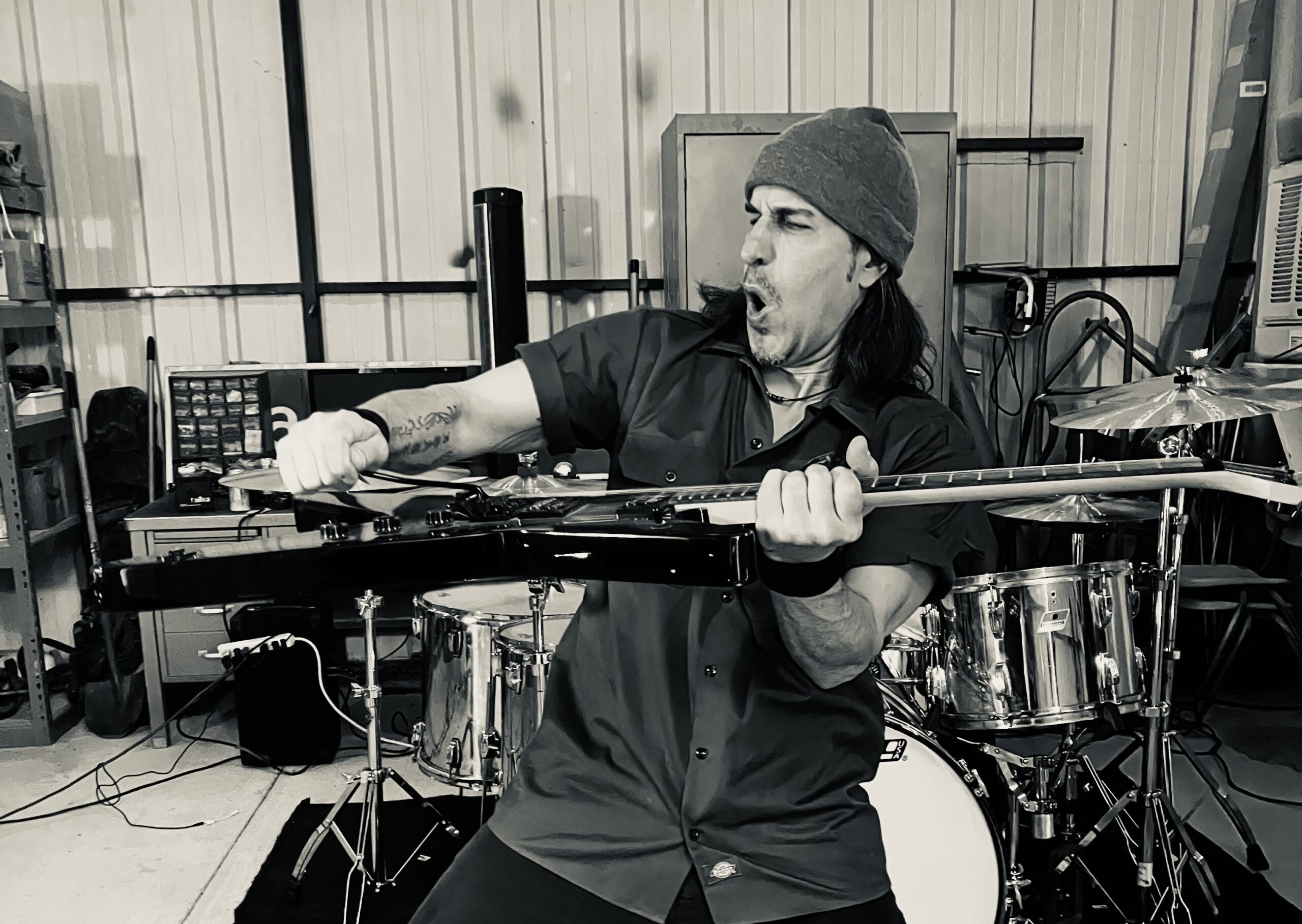
Drummer, vocalist, songwriter, and multi-instrumentalist Brian Tichy has spent decades as one of rock’s most in-demand sidemen, holding down the rhythm section for Whitesnake, Foreigner, Billy Idol, and Gene Simmons, among others. Now he’s stepping out from behind other artists’ songs with Led By Vultures, a new band built entirely around his own vision — one that fuses heavy, classic-rock-rooted riffing with the kind of melodic ambition that comes from a lifetime spent studying the greats.
The band’s self-titled debut arrives August 28, 2026, on limited purple vinyl, CD, and digital formats, with a signed album-flat bundle available for a limited run. Ahead of the release, Led By Vultures dropped “Waves,” a more reflective, melody-forward cut co-written with keyboardist Derek Sherinian, complete with a flute-laced bridge and a music video shot on an overcast day at Malibu’s El Matador Beach.
We caught up with Tichy to talk about the long road to going solo, what it means to finally be the guy out front instead of the guy keeping time, and why Led By Vultures feels less like a side project and more like unfinished business.
Pre-order the CD, vinyl, and exclusive bundles while supplies last: https://www.dekoentertainment.com/inthesquare/led-by-vultures
Antihero Magazine: Brian, you’ve lived so many musical lives that it’s almost impossible to summarise your career in one breath. When you look at the journey as a whole, what’s the first chapter that still feels foundational to who you are today?
Brian Tichy: That would be simply playing along to all my favorite records as a kid all the way through high school. I would try to play the records as if I was in the band. It was mostly “fun” as I loved the art of playing and learning how to play the drums. But I was focused, and it was also a challenge and a test. I think without really knowing it, I was preparing myself for the future.
Antihero Magazine: You’ve played with artists who each have their own gravitational pull — from arena-level legends to raw, gritty rock outfits. What did those early experiences teach you about the kind of musician you wanted to become?
Brian Tichy: Each experience makes you better prepared for everything else to come. You don’t really see it like that in the beginning, or maybe even down the road, but like anything, unless you aren’t paying any attention, you are learning as you go. Those experiences didn’t dictate the kind of musician I wanted to become. That comes from yourself. But it can push you to more or less realize who you mostly are, and it’s up to you to hone in on that and be your own person/musician.
Antihero Magazine: Before we get into the new album, I’m curious: when you think about your career from the outside, what do you think people most misunderstand about the path you’ve taken?
Brian Tichy: I’m not really sure, but it’s probably that if you see me playing with many different bands, you may assume that’s what I’m all about, which makes sense from the outside. But I’ve always wanted to have my own band just like the bands I’ve played in. To me, that’s the pinnacle of being a musician; being known for something you’re a part of creating.
Antihero Magazine: Your résumé reads like a map of rock history. How did moving between bands like Whitesnake, Foreigner, Billy Idol, Gene Simmons shape your instincts as both a drummer and a songwriter?
Brian Tichy: I think I was pretty prepared for all these types of gigs, as far as rock drumming goes, long before I was in the bands. My whole life was about being a drummer, so to me, I’ve had no excuses not to be able to handle a rock drumming gig. But of course you learn what can or can’t work in various settings. And that is unknown until you actually do it. And that’s what can make you better. As far as songwriting, that simply comes down to the individual. Anyone can go for writing any style they want, regardless of who they’ve hired by. But I’ve been fortunate to play with bands whose music I love. That influence was always there, and it probably rubs off a bit more by simply being in the band playing those songs.
Antihero Magazine: You’ve been the rhythmic backbone for so many iconic voices. Was there a moment with any of those artists where you realised, “I’m learning something here that I’ll use later for my own music”?
Brian Tichy: Well, probably not as much as songwriting, because I’m already familiar with the songs and music from being a fan. But by playing these artists’ great music and seeing how the fans react definitely influences your bigger picture of how you’d like to see people react to your own music. I think I learned more about how artists run their business and how they’ve lasted and continued over decades. All that is a constant flow of inspiration.
Antihero Magazine: You’ve always balanced technical power with feel — that intangible human element. How did that philosophy evolve as you moved from sideman to collaborator to band member across different eras?
Brian Tichy: I play how I play, but I do try to play to enhance the overall sound of the band and make the band sound as good as it can. And I have big ears and listen. If something needs to be approached in a certain way I’d like to think I can do that without question. I attribute that to decades of focused practice long before I was in those positions. That comes from really listening to what is going on around you as far as the song, the band, whether it’s in the studio or live. I’ve always tried to be able to play close to how I hear my favorite drummers play, which really helps when you get involved with new bands and no two bands are exactly alike and there are many things to take into consideration.
Antihero Magazine: There’s a physicality to your drumming that fans instantly recognise. How did that identity survive — or transform — as you navigated such diverse musical environments? But all that simply comes from lots of practice.
Brian Tichy: Drumming is physical, and to me it’s always been a lot of fun when you are able to really dig in and push yourself. It’s exciting to be able to let loose in that respect. It keeps you young too! I enjoy the physical release. There aren’t that many occupations on this planet where you can release a ton of energy, and while doing it, make people dance, clap their hands, and have a good time! Drumming and rock n roll is one of them! But I have done gigs where bashing it up wouldn’t really be the right choice, and I have no problem laying back and playing for the music. You have to be able to tighten up the reins and control that stuff as well!
Antihero Magazine: At what point did the idea of a solo album stop being a distant thought and start becoming a real creative need?
Brian Tichy: I’ve always wanted to but procrastinated for far too long. You get older and go, “uh, what are you waiting for dude!?” I had my own band in the late 90’s where I played guitar and sang and wrote the songs. I put a record out in Japan and had a deal in the U.S., but the label went under right before it came out. Soon after I had kids and priorities changed. So fast forward to last year and I was in a place in my life where I just knew I didn’t want to push it off any longer. I have a studio in my house so I have no excuses. I put the first drum track down, and that was enough to kick it all into gear.
Antihero Magazine: You’ve spent decades helping other artists bring their ideas to life. What was the moment you realised you had a story of your own that couldn’t be told from behind the kit?
Brian Tichy: Oh, that all goes back to high school. I’ve played guitar since like 7th grade and was always writing riffs and song ideas. It’s actually kind of embarrassing that I’ve been doing it for so long and haven’t made it a bigger part of my professional musician life. I love playing drums and playing with all these big artists has been awesome and given me tons of great experiences and memories. And I have put together my own smaller bands like Something Unto Nothing with Sass Jordan, and Silverthorne with Pete Shoulder, but this biz isn’t easy, and it takes money to continue these kinds of projects, so you need to keep working in other places to pay the bills. In my case, it’s hitting drums. I’ve also written a ton of songs for a company that gets the songs in movies, commercials, TV shows and stuff for the past 25 years. So I’ve had other outlets where I’m writing music, but Led By Vultures was a conscious effort to do it all on my own and have it as a newly paved road I can travel down for decades to come.
Antihero Magazine: Was there a specific tour, session, or personal moment that made you think, “It’s time — I need to step forward and make something that’s entirely mine”?
Brian Tichy: I just knew I had to do it for me and Father Time waits for no one! But there was a bit of a moment. At the beginning of 2025, we had all these fires in LA, and it just stops you in your tracks as nothing you are doing is nearly as important as it was before these fires were creating so much devastation and loss. That, coupled with me putting a lot of time into really digging into learning a bunch of Eddie Van Halen stuff. I put some friends together and we did a gig. This was soon after the fires. I woke up the next day and was like “you can keep learning Van Halen songs on guitar and playing local bars, or you can start your own record.” That kinda made it obvious to me.
Antihero Magazine: This new album feels like a declaration — not just musically, but personally. What was the emotional starting point for it?
Brian Tichy: I wanted to get this record together and simply show another side of what I have spent a lot of time doing in my life, that’s not just playing drums for the famous guys! It started to really irk me that it’s all been on a back burner for so long. No one but me can change that.
Antihero Magazine: When you began writing, did you approach the songs as a drummer first, or did you deliberately force yourself to think like a songwriter and storyteller?
Brian Tichy: The drums are just a part of the song. I don’t think like a drummer when writing music. I think about the effect I want the song to have on the listener, and that usually involves loud guitar riffs and powerful groovy drums!
Antihero Magazine: You’ve worked with some of rock’s most distinctive voices. How did you find your own vocal identity without slipping into the shadow of singers you’ve supported?
Brian Tichy: I’ll always be in the shadow of the singers I’ve supported because they are all killer, iconic singers. I just try to hit the notes! And trust me, if I could sound more like a Lou Gramm or David Coverdale, or Ozzy, or any of the amazing singers I’ve been able to work with, I would! I’m not a natural singer by any stretch. But like anything, the more you do it, the better you get.
Antihero Magazine: Were there any songs that started as pure rhythmic ideas but transformed into something completely different once you leaned into melody and lyric?
Brian Tichy: Not really. Most of the songs with guitar riffs started out as just that. Then I just hum and mess around with vocal ideas. I had some titles written down, and if a musical idea seemed to work with a title, then I’d put that together.
Antihero Magazine: Your guitar work on this record has a looseness and swagger that feels very “you,” but also very new. What changed in your approach to tone and phrasing when the songs were yours?
Brian Tichy: I simply play how I play. The whole record is really just that. It’s me on my own trying to sound like a kick-ass rock band. I love groove, I love guitar riffs, I love when it’s all put together for the first time, and you hear the power of it all. I’m very aware of trying to play tight, but I also enjoy a certain amount of looseness where “if it feels right, it is right.” No one was telling me what to do and that could be a good thing but it can also leave you alone, second-guessing forever. But you have to be able to produce yourself and not go down a rabbit hole of indecisiveness. I love the whole process of making a record, and the most fun to me is recording rhythm and lead guitars.
Antihero Magazine: Is there a production choice on the album — something subtle, maybe even hidden — that you’re quietly proud of because it captures a side of you listeners haven’t heard before?
Brian Tichy: It’s all organic. There’s no auto-tune. I don’t own it. The drum tones are all real. I barely use any fake reverb on drums. It’s mostly compressed room mics. The guitars are played through a Marshall cabinet and 5150 head. I mixed and mastered this on my own and wanted it to represent sounds I get on my own. That was really important to me. I wanted it to have the same spirit as all the killer bands in the 70’s, before there was too much studio trickery. I’m talking about the meat of the band, and how they all sounded unique. Zep, Queen, Aerosmith, The Who, Van Halen, etc. The musicians are what make the records sound how they sound. Everything else is icing.
Antihero Magazine: Which track pushed you the furthest outside your comfort zone, and what did you learn from that stretch?
Brian Tichy: Probably “Waves” because I had to sing it and not just yell. It’s an old song I’ve had for a long time, but I wanted to rewrite the lyrics and verse melody, and it was hard to get away from the old demo words and melody. It may not be a hard song to sing, but when you are imagining how it would sound if you had a Steven Tyler or Robert Plant singing it, and you aren’t that, it makes it a bit of a challenge to try to catch the vibe that’s in your head.
Antihero Magazine: If there’s one song on the album that reflects who you are right now — not the sideman, not the résumé, but the artist — which one is it and why?
Brian Tichy: The real answer is the whole record. It’s me writing and recording it all from the ground up, on my own, with the intent of releasing it as just that. But, to condense that; it’s probably mostly a combination of “Waves” and “Get It Right” or “Massivity.” I love chords and melody and I love big fat heavy riffs. So between those two songs, that’s a decent representation of this record and where I’m at.
Antihero Magazine: You’ve spent your life contributing to other people’s legacies. What does it feel like to finally present a body of work that begins and ends with your own creative fingerprint?
Brian Tichy: It’s just nice to have it completed without it having dragged on too long in a haze of second-guessing. I said I would do it, and got it done. Cool… I’m just another musician putting out my own music. It’s not like I’m curing cancer so you can’t make it this overly-dramatic thing. I’m just happy to have it done and not look at these song ideas on hard drives anymore. Of course I hope people dig it, as I plan on continuing with more music.
Antihero Magazine: Now that this album exists in the world, how do you see it reshaping the next chapter of your career — not in terms of opportunity, but in terms of identity?
Brian Tichy: I would love to see this band play live and get to the next level. I’d like to be seen and known as more than just a drummer. That’s a lot to do with why this record was made. I’ve been doing all this other stuff for so long, and it’s kinda weird not to try to let that be known more, considering the amount of time I’ve put into other instruments and writing and recording.
Watch the music video for “Waves” here: https://www.youtube.com/watch?v=AdYVOqSVn1k