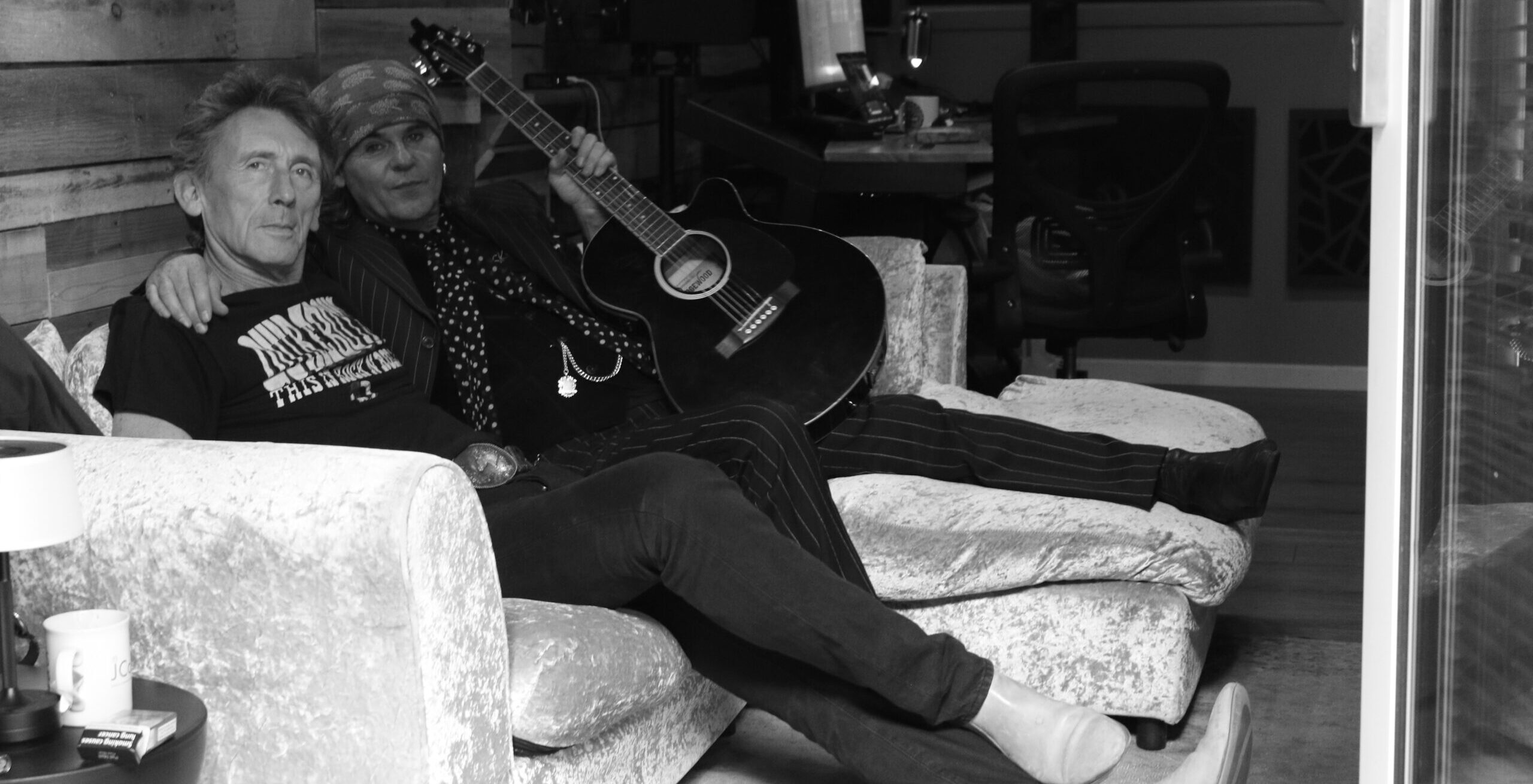
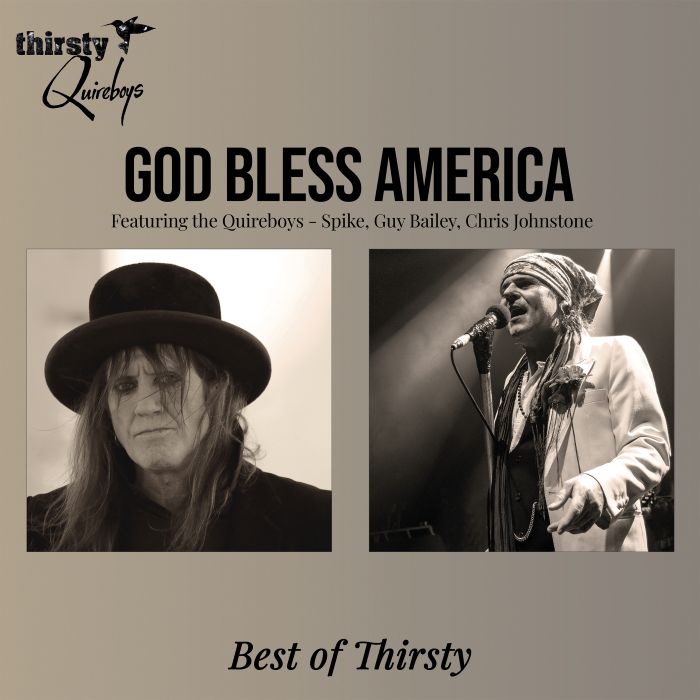
Guy Bailey spent his career writing songs that served the song, not himself. As founder of The Quireboys and the guitarist and songwriter behind Thirsty, he was, in his own quiet way, one of British rock’s most distinctive architects — a man whose home was as full of books as his catalogue was full of melody. Following his passing, God Bless America – Best of Thirsty was conceived as a tribute to that legacy. What it became is something far more complicated and far more moving.
The record began simply: Spike, longtime friend and Bailey’s original Quireboys co-founder, was invited into the studio to sing just one track. That track was meant to be a farewell gesture. Instead, the first playback stopped the room cold — Spike’s voice moving through Bailey’s guitar work like the two had never stopped playing together. One song became the whole album, remixed and reshaped by Rolling Stones producer Chris Kimsey, turning a planned compilation into something closer to a posthumous reunion.
At the album’s center sits its title track, “God Bless America” — a haunting retelling of the true story of Rosemary Kennedy, set to Irina D’s lyrics and one of Bailey’s looping, discordant motifs. It’s just one entry in a catalogue built on storytelling borrowed from elsewhere: Hitchcock and a real Cannes jewel heist on “Flawless,” Donnie Brasco on “Donnie to Sonny,” Virginia Woolf on “Orlando,” Coleridge on “Albatross.” Thirsty was always Bailey’s melodic instinct fused with Irina D’s love of literature, and this album is the clearest picture yet of how that partnership worked.
We sat down with Chris Johnstone, Spike, and Irina D to talk about revisiting Bailey’s recordings, what changed once his voice was gone but his guitar remained, and why what started as a tribute became something that feels, in their words, like a continuation rather than an ending.
Antihero Magazine: What was the first moment you realised, “This isn’t just another record. This is a new chapter”?
Chris Johnstone: The idea of putting together a Best of Thirsty as a tribute to Guy had been around for well over a year. Originally, it was just going to be a normal compilation of our favorite songs. But then we invited Spike to sing just one song. We were all at First Studios in Holloway when Dave played back the first take. The moment Spike’s voice came through Guy’s guitar, we all looked at each other. It is when you know something special has happened. One song became two, then three. Once, in one of those rare moments in the studio, Chris Kimsey came on board to remix the album, and it became obvious we were not simply revisiting old recordings. We were creating something entirely new.
Spike: I honestly thought I was just coming in to sing one song for Guy. Then I heard it back and thought, “Hang on, it just felt right. There was something really natural about hearing my voice with Guy’s guitar again. Nobody had to persuade me after that.
Antihero Magazine: Was there a song on the album that completely changed direction halfway through writing it, and what caused the shift?
Chris Johnstone: Not really, because the songs themselves had already been written and recorded, some more than a decade ago. What changed was the way we approached them. Guy’s original guitar performances were unchanged, but Spike’s vocals and Chris Kimsey’s new mixes gave the songs, and the sound of Guy’s guitars give a completely fresh perspective. That’s what makes the album quite unusual. It lies somewhere between a remix, a reinterpretation, and a brand new record.
Antihero Magazine: Which track on the album surprised you the most once it was finished, either emotionally or sonically?
Chris Johnstone: Probably White. Spike came into the studio with a very clear idea of introducing a falsetto vocal in places, a little in the spirit of Mick Jagger on Emotional Rescue. Chris Kimsey’s mix gave it a completely different atmosphere, and suddenly the song revealed another side of itself.
Spike: For me, it was God Bless America. I didn’t want to oversing it because the story is already so powerful. I just tried to let the emotion build naturally. Sometimes the less you do, the more the song speaks for itself.
Antihero Magazine: Did any lyrics come from a place you weren’t expecting to revisit?
Irina D: Not on this album because the lyrics had already been written. What was fascinating was hearing somebody else inhabit them. Every singer brings something different to a lyric, and Spike found colours and emotions in some of the songs that surprised me. It is rather like watching another actor perform a part you’ve written. The words stay the same, but the character subtly changes.
Antihero Magazine: If you had to describe the album’s emotional arc without using musical terms, what story is it telling?
Irina D: I don’t think there is a single story because the songs were never written with one overarching narrative in mind. Some are inspired by history, literature, or cinema, while others are much more personal or poetic. Guy and I always enjoyed moving between those different worlds. “God Bless America” follows the tragic life of Rosemary Kennedy. “Flawless” was inspired by both Hitchcock’s To Catch a Thief and a real jewellery heist in Cannes. “Donnie to Sonny” draws on Donnie Brasco. “Orlando” was inspired by Virginia Woolf, while “Albatross” owes something to Coleridge’s The Rime of the Ancient Mariner. But other songs come from much more personal places. We never wanted every song to be written in the same way.
Antihero Magazine: What’s one production choice on the album that most listeners probably won’t notice, but you’re quietly proud of?
Chris Johnstone: Chris Kimsey deserves enormous credit for this record. He has that rare ability to make recordings sound bigger and clearer without losing their character. Spike also approached every song differently. The falsetto in “White” is the obvious example, but there are dozens of much smaller decisions throughout the album. The dynamics, the phrasing, holding back in places. Those are often the details that musicians notice first.
Antihero Magazine: How did the dynamic between Spike’s vocals and Guy’s guitars evolve compared with the original recordings?
Spike: Guy never played guitar to show off. Everything he played served the song, and that’s a lovely thing for a singer because you are never competing with the guitar. You are working together.
Chris Johnstone: Exactly. Guy played every guitar part on the original recordings, so nothing there has changed. But somehow adding Spike’s voice makes people hear Guy’s playing differently. It shines another light on just how distinctive he really was as a guitarist and songwriter.
Antihero Magazine: Was there a moment in the studio where you thought, “We’ve never sounded like this before”?
Spike: The first playback. Nobody said very much. We just smiled.
Antihero Magazine: If you had to pick one track that best represents the DNA of Thirsty Quireboys, which one would it be and why?
Irina D: Probably “God Bless America.” It brings together so many of the things that matter to us: trying to tell a human story rather than simply writing about ourselves. Things that define the project. A true story that becomes a song, Guy’s instinct for melody, Chris Kimsey’s production, and Spike’s remarkable vocal performance. It also captures something else that has always mattered to us: trying to tell a human story rather than simply writing about ourselves.
Antihero Magazine: This album marks a fresh identity for the project. What was something you refused to leave behind, and something you wanted to embrace?
Chris Johnstone: There was never any question about preserving Guy’s performances. They are the heart of the record. What we embraced was the opportunity to hear them from a different perspective. Nobody set out to reinvent the music. It evolved naturally once Spike became involved, and Chris Kimsey started remixing the recordings. Looking back now, what began as a tribute somehow became a continuation. I think that’s what makes the album feel so special.
Antihero Magazine: How do you balance honouring the band’s history with permitting yourselves to evolve?
Spike: You can’t spend your life worrying about whether people think you’ve changed too much or not enough. You just make the best record you can. If it feels honest, people usually get it. We weren’t trying to recreate the past. We were trying to do justice to Guy’s songs.
Chris Johnstone: That’s exactly right. We never set out to modernise the recordings for the sake of it. Chris Kimsey understood that from the beginning. His mixes opened the songs up without changing their character. The aim was always to let people hear them afresh while remaining completely true to what Guy created.
Antihero Magazine: What do you hope long-time fans hear in this album that tells them, “Yes, this is still us”?
Chris Johnstone: I hope they hear what we all heard in the studio. The chemistry between Guy’s guitar and Spike’s voice. Those two elements were always at the heart and soul of the Quireboys, and hearing them together again in this completely different context feels surprisingly natural. I also hope Thirsty fans recognise that the songs themselves haven’t changed. We’ve simply looked at them from a new angle.
Antihero Magazine: If the album had a mission statement, not for the fans but for yourselves, what would it be?
Irina D: To celebrate Guy Bailey as both a songwriter and a guitarist. People often talk about his playing, quite rightly, but I don’t think his songwriting has always received the recognition it deserves. If this album encourages people to discover, or rediscover, those songs, then we have achieved something worthwhile.
Antihero Magazine: Spike, your vocal delivery on this album feels more lived-in and narrative. Was there a moment in the sessions when you realised you were singing these songs differently?
Spike: Definitely. A lot of these songs ask you to become somebody else for three minutes. Before we even went into the studio, I already had ideas about where I wanted to push my voice, where I wanted to hold back, and where I wanted to change its colour. That is one of the things I enjoyed most about making the record.
Antihero Magazine: Which lyric on the album feels closest to who you are right now, not who you were?
Spike: I don’t really think in terms of favourite lyrics. For me, it’s always about whether I sing it. When that happens, the lyric becomes mine for those few minutes. Believe it.
Irina D: That’s an interesting question because lyrics have a life of their own. Some feel exactly as they did when Guy and I wrote them, while others seem to reveal new meanings with time. Revisiting this catalogue has also encouraged me to return to writing. Over the past year, I’ve found myself writing new lyrics and poetry again, and that has been one of the unexpected pleasures of the project.
Antihero Magazine: Chris Guy’s guitar work has always been admired. What do you think this album reveals about him that perhaps people haven’t fully appreciated?
Chris Johnstone: I think it reminds people just how complete a musician Guy was. He wasn’t simply a wonderful guitarist. He wrote memorable songs, understood melody instinctively, and always played for the song rather than for himself. Having Chris Kimsey remix these recordings has brought out details that even I hadn’t fully appreciated before.
Antihero Magazine: Was there anything that surprised you as you revisited these recordings?
Chris Johnstone: Yes. Time gives you perspective. Listening to these recordings again, I was struck by how well they have stood up. Chris Kimsey’s mixes have given them new clarity, but the performances were already there. That’s a testament to Guy’s writing, playing, and the musicians who made those records.
Antihero Magazine: Which song do you think will take on a completely different life once you play it live?
Spike: 10, 7, and possibly 6. It’s got a fantastic riff, loads of energy, and plenty of room to stretch out. I think audiences are going to have a lot of fun with that one.
Antihero Magazine: Is there a track you expect fans to latch onto for reasons you didn’t anticipate?
Chris Johnstone: I hope so. That’s one of the joys of making records. Every listener hears something slightly different. Sometimes the song you think will be the obvious favourite isn’t, and another one quietly develops a life of its own.
Irina D: I’ve always liked that about songwriting. Once the songs are released, they no longer belong entirely to us. People bring their own memories and experiences to them, and often discover meanings we never consciously put there.
Antihero Magazine: If you could play the album from beginning to end in one venue that perfectly matches its atmosphere, where would it be?
Spike: Somewhere intimate. A proper late-night rock and roll club. The sort of place where people are close enough to feel every song rather than just hear it. That has always been the natural home for this kind of music.
Listen to the album on Spotify: https://open.spotify.com/album/2jkWiPjxr1KXCvKbpwylsU?si=E50P57djRHyE3qNEa6wDWw
ORDER THE ALBUM HERE: https://cadizmerchstore.com/products/thirsty-quireboys-god-bless-america-best-of-thirsty?_pos=1&_sid=d0bcafa6e&_ss=r