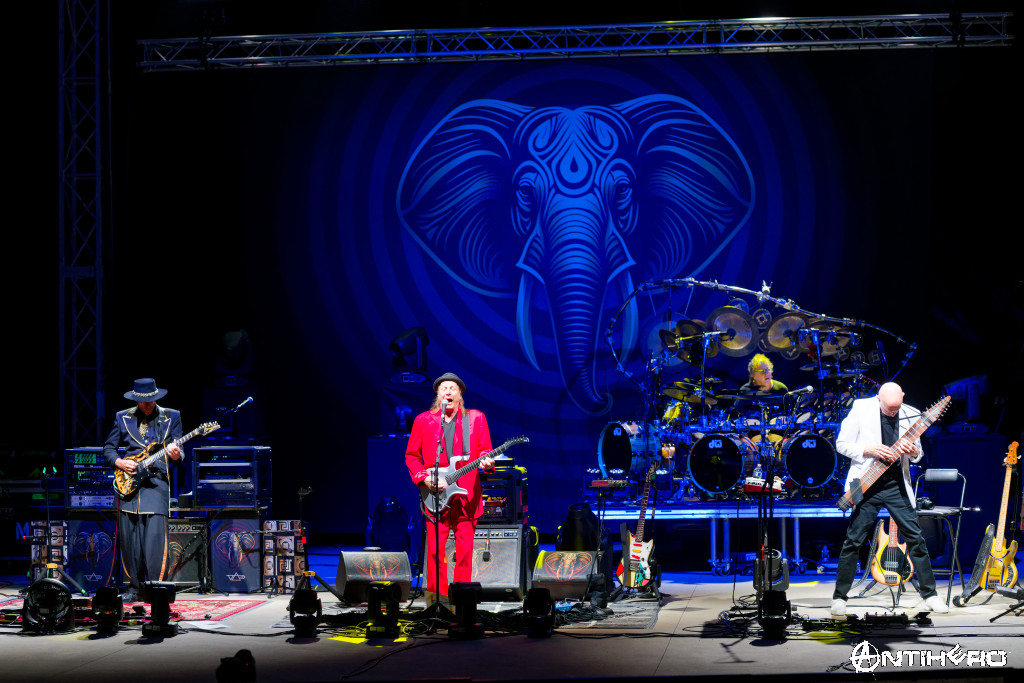
Santa Cruz, California | October 9, 2026
Some music never loses its ability to surprise. Decades after redefining the possibilities of progressive rock, the music of the 1980s remains intricate, unpredictable, and every bit as challenging as when it first appeared. On October 9, BEAT brought that adventurous spirit to the Quarry Amphitheater in Santa Cruz, kicking off its tour with a performance packed with complex arrangements, unexpected turns, and impressive musicianship.
Featuring Adrian Belew, Tony Levin, Steve Vai, and Terry Bozzio, BEAT is a formidable lineup. Belew and Levin helped shape this era’s original sound, while Vai brings his distinctive guitar style to the material. Bozzio, a veteran of Frank Zappa’s band and a boundary-pushing drummer in his own right, adds another dimension to the music, demanding both precision and imagination.
The Quarry Amphitheater was an ideal setting for the occasion. Tucked among the redwoods on the UC Santa Cruz campus, the venue feels a world away from a typical arena show. Against that backdrop, the band’s intricate, sometimes ferocious music offered a striking contrast to the surrounding landscape.
“Neurotica” opened the show with plenty of nervous energy, immediately establishing the evening’s restless character. “Neal and Jack and Me” and “Sartori in Tangier” followed, showcasing the intricate guitar interplay and shifting rhythms that define this material.
Belew remains one of rock’s most distinctive guitarists. His playing moves effortlessly between tightly constructed patterns and strange, almost vocal sounds, giving each song a personality of its own. Rather than relying on conventional guitar heroics, he finds ways to make the instrument snarl, chatter, and occasionally sound as though it has a mind of its own.
“Three of a Perfect Pair” continued the run of familiar favorites, with Vai adding his own voice to the arrangements. His technical ability is never in question, but what makes him such an effective fit is his willingness to work within the music rather than turn every passage into a solo showcase. When the two guitarists lock into the same rhythmic patterns, the results are particularly satisfying.
“Walking on Air,” making its BEAT debut, offered a welcome change of pace. The song’s more reflective character revealed a gentler side of the band’s repertoire, proving that complexity doesn’t always have to come with volume or aggression.
“People” was another BEAT debut and a particularly intriguing choice, having last been performed by King Crimson members in 1996. Its inclusion gave longtime fans something beyond the expected selections and demonstrated that the group was willing to dig deeper into the catalog.
The mood shifted with “Industry,” a darker, more atmospheric piece built around tension and layered rhythmic patterns. The song doesn’t offer easy resolutions; instead, it draws the listener into its unsettling structure. The first set concluded with “Larks’ Tongues in Aspic (Part III),” a powerful, hard-edged finale that brought the musicians’ precision and intensity to the forefront.
Throughout the set, Tony Levin provided a remarkable foundation. His Chapman Stick playing allows bass lines and melodic figures to coexist, adding depth and movement to the arrangements. His contribution goes well beyond keeping time; he is an essential part of the music’s architecture.
Behind the kit, Bozzio brought considerable authority to the proceedings. The material’s constantly shifting meters and accents are demanding even for experienced players, but he approached them with confidence, balancing technical detail with the power needed to keep the music moving.
The second set opened with “Waiting Man,” one of the defining tracks from the Beat album. Its interlocking patterns and rhythmic shifts reminded everyone how carefully constructed these compositions are. In the hands of this lineup, the complicated arrangements felt like a conversation rather than an exercise in technical showmanship.
“Dinosaur,” also making its BEAT debut, brought a different character to the evening, expanding the set beyond the best-known 1980s material. “Dig Me” continued that exploration before “The Sheltering Sky” opened up a more atmospheric stretch of the performance.
“The Sheltering Sky” benefits from patience and restraint. Rather than rushing toward a dramatic payoff, the musicians allowed the piece’s mood and texture to develop. It was an opportunity to appreciate the subtler side of the band’s musical identity.
“Sleepless” brought the energy back up, driven by Levin’s muscular bass work and the guitars weaving around one another. The song’s forward momentum made it one of the set’s more immediate highlights, demonstrating how rhythmic complexity can still deliver a powerful physical punch.
“Matte Kudasai” provided one of the evening’s most delicate moments. Belew’s vocal delivery and the song’s understated arrangement offered a welcome contrast to the heavier material. Amid all the intricate musicianship, it reminded us that a simple melody, handled with care, can be as compelling as the most complicated instrumental passage.
The opening patterns of “Frame by Frame” brought the audience back into familiar territory. Its interlocking guitar figures remain instantly recognizable, and watching Belew and Vai navigate the arrangement was a highlight for anyone who appreciates the mechanics behind great musicianship.
“Elephant Talk” introduced a more playful mood. Belew’s eccentric guitar sounds and the song’s offbeat personality were front and center, giving the performance a sense of humor that can sometimes get lost amid all the technical discussion surrounding progressive rock.
The main set closed with “Indiscipline,” a muscular, unpredictable piece that combined heavy instrumentation with shifting dynamics and a healthy dose of controlled chaos. It was an ideal way to finish the set, bringing together the intensity, humor and adventurous spirit that define the band’s repertoire.
For the encore, BEAT reached outside its core repertoire with Frank Zappa’s “City of Tiny Lites,” another debut for the project. The choice made perfect sense. Zappa and the musicians behind this music share a willingness to challenge conventional rock structures, and the song fit naturally into the evening’s adventurous atmosphere.
“Thela Hun Ginjeet” closed the show with driving rhythms and plenty of attitude. It was a fitting final selection, sending the audience out with one last reminder of the music’s restless energy.
What makes BEAT work is that this isn’t simply a group of accomplished musicians recreating old records. These arrangements are too intricate, too unpredictable, and too dependent on the personalities involved for that approach to be enough. Belew and Levin bring their firsthand connection to the material, Vai adds his own unmistakable guitar voice, and Bozzio brings a rhythmic sensibility that keeps the performances feeling fresh.
The set list struck a good balance between familiar favorites and less frequently heard selections. “Frame by Frame,” “Elephant Talk,” and “Indiscipline” delivered the expected highlights, while “Walking on Air,” “People,” and “Dinosaur” added an element of discovery. The Zappa cover was a welcome surprise, reinforcing the connection between musicians who have always pushed rock beyond its usual boundaries.
The performance set a strong tone for the tour, combining classic material, deeper cuts, and new additions to the BEAT set list. Across two sets, the band showed how much variety this music can offer without losing its distinctive character.
This is music that demands attention. It can be beautiful one moment and abrasive the next, moving from tightly controlled precision to apparent chaos without warning. The trick is making those contrasts feel natural, and this lineup understands how to bring that balance to the stage.
At the Quarry Amphitheater, BEAT offered more than a trip back to the 1980s. The performance celebrated a body of work that still sounds adventurous decades after it was created. Belew, Levin, Vai and Bozzio approached the material with the skill it demands and the freedom it deserves.
For fans of progressive rock, the evening reminded them that great music doesn’t lose its relevance with age. Sometimes, it simply finds another way to surprise you.
BEAT