There are few things more satisfying in progressive rock than watching musicians take a format that should be physically impossible and make it sound completely natural. On Sunday, September 20, Stick Men—Tony Levin, Pat Mastelotto and Markus Reuter—turned the UCSC Music Center Recital Hall into a laboratory for rhythm, texture and controlled sonic mayhem. The 8 p.m. Santa Cruz performance was part of the band’s Let’s THRAK Again tour, supporting the new album of the same name, a tribute to King Crimson’s 1995 album THRAK made with Robert Fripp’s blessing.
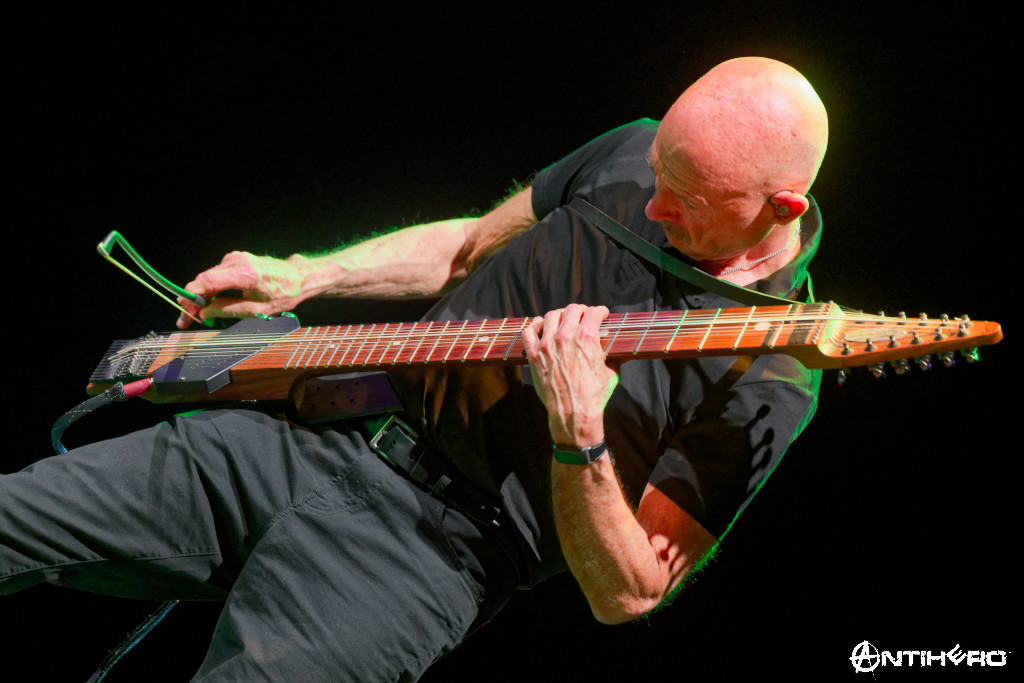
The evening began with “Improv,” an appropriate opening statement for a band whose live identity depends as much on interaction as composition. Rather than easing the audience into the evening, Stick Men immediately established the vocabulary: Levin’s Chapman Stick supplying bass weight and melodic counterpoint, Reuter’s touch guitar filling the upper register with everything from jagged attacks to atmospheric textures, and Mastelotto constructing an enormous rhythmic landscape from acoustic drums and electronics. The trio’s instrumentation gives them the sonic footprint of a much larger ensemble, while the visual reality remains three musicians locked together onstage.
“Cusp” and “Brutal” pushed that tension between precision and improvisation further. The music can be sharply angular one moment and surprisingly spacious the next. “Brutal” in particular lived up to its title, with Mastelotto’s drumming providing a relentless engine underneath Levin and Reuter’s interlocking lines.
Then came “Ringtone” and the title track, “Let’s THRAK Again,” which made the purpose of the tour unmistakable. The latter has the DNA of the King Crimson universe without simply functioning as nostalgia. Stick Men have taken that vocabulary—odd meters, muscular bass, metallic guitar textures and sudden dynamic shifts—and made it their own. The band describes its music as blending art rock and progressive rock with an emphasis on improvisation, and live, that description makes considerably more sense than any conventional genre label.
The middle of the set was particularly strong. “Crack in the Sky,” “Tentacles,” “Fandango,” and “Mantra” moved through contrasting moods without breaking the momentum. “Fandango” brought a different rhythmic character to the performance, while “Mantra” demonstrated how effectively the trio can create atmosphere without sacrificing their characteristic density.
The first of three King Crimson pieces, “VROOOM VROOOM,” followed. It’s drawn from THRAK itself, which tied it directly to the premise of the tour. Given Levin’s and Mastelotto’s histories with King Crimson, these songs aren’t generic covers. The connection is fundamental to the sound and history of Stick Men. The performance retained the piece’s mechanical intensity while giving Reuter considerable room to put his own stamp on the guitar textures.
The subsequent run of “The Well,” “Komodo,” “Swimming in Tea,” and “Prog Noir” was a showcase for the band’s newer material. “Swimming in Tea,” with its improvisational possibilities, was especially suited to the concert setting. Across the evening, the distinction between a written composition and an improvised performance seemed deliberately porous: themes emerged, fractured, disappeared and returned in altered forms.
The main set concluded with “Larks’ Tongues in Aspic, Part Two,” another King Crimson composition and perhaps the clearest bridge between Stick Men’s present and the musical history that helped create them. It was followed by a one-song encore: “Level Five.”
Ending with “Level Five” was fitting. The piece is built around propulsion and repetition, but in Stick Men’s hands those qualities become something almost physical. Mastelotto’s rhythmic attack, Levin’s formidable low-end presence and Reuter’s guitar work combined into the kind of dense, aggressive sound that makes a three-piece seem vastly larger than it is.
The Santa Cruz concert ultimately worked because Stick Men never treated technical ability as the point of the evening. The musicianship is obvious—almost unavoidable—but the performance was about what those abilities make possible: three players listening closely enough to one another to create music that can move from tightly arranged passages into spontaneous exploration and back again.
The 16-song performance, including the encore, covered material from Let’s THRAK Again, Prog Noir, Tentacles, Deep and the band’s King Crimson repertoire. The result was a concert that felt less like a conventional progressive-rock recital and more like an extended demonstration of what can happen when rhythm, technology and improvisation are given equal billing.
For a band built around instruments and techniques that can easily become exercises in virtuosity, Stick Men kept the emphasis where it belongs: on the music.
Stick Men