There is a painting on the cover of Graveyards of Joy — Ruïnes (1865) by Catalan artist Lluís Rigalt that tells you nearly everything you need to know before the first note sounds. Stone arches are consumed by vegetation. Desolation wears beauty like a second skin—something dead, something growing, the two indistinguishable from a distance. The Anglo-Spanish duo at the heart of TodoMal didn’t choose it by accident. They recorded this album in the same terrain: a crumbling stone house in the depopulated interior of Eastern Spain, near Teruel, where abandoned railway stations decay quietly in the sun, and the air carries what Chris Wildman has called the silence of “godforsaken areas.” That environment isn’t a backdrop — it is an argument. Graveyards of Joy insists that landscape and interior state are the same thing, and for forty-three minutes, it proves the case.

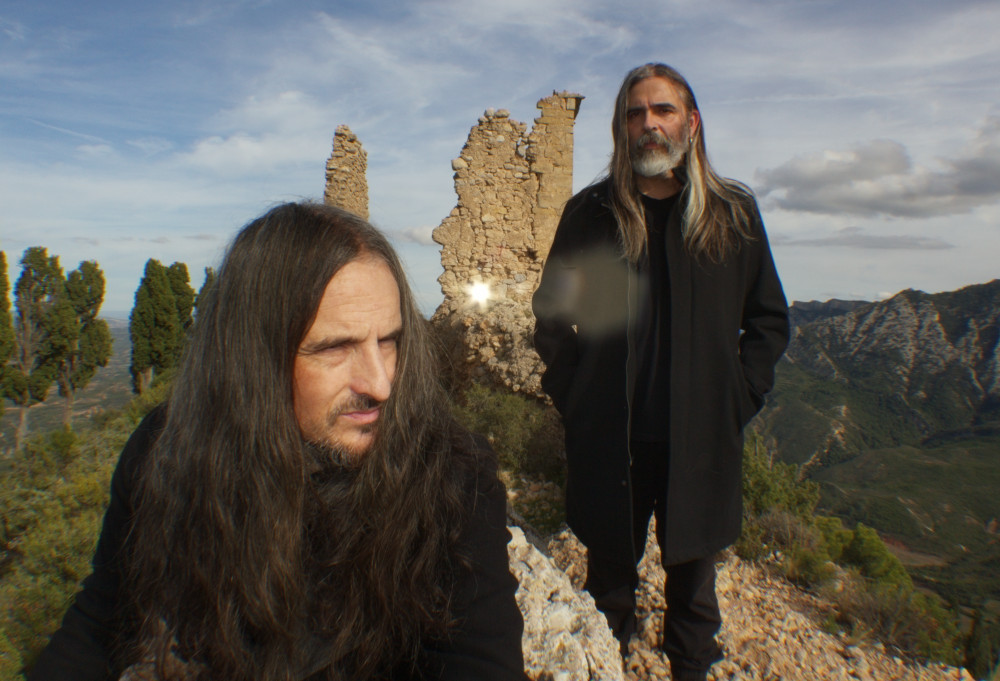
TodoMal emerged in 2020 from the partnership of Wildman and Javier Fernández Milla, two veterans of the Spanish underground with careers spanning projects from thrash to ambient. Their 2021 debut, Ultracrepidarian, evoked the moorlands of northern Alcarria with the deliberate patience of a band with nothing to prove. A Greater Good (2023) deepened the palette — denser, less classifiable, landing on multiple year-end lists and selling through its first pressing. The band that made those records is gone, not through dissolution but through expansion: a live five-piece now includes guitarist Javier Félez (Teitanblood, Graveyard), drummer Javier “Bud” Martínez, and vocalist and keyboardist Cecilia Tallo, whose contributions prove decisive on this record. Graveyards of Joy closes what both band and audience have recognized as a trilogy, and it does so with the weight that implies — a final statement rather than a next step, a reckoning rather than an evolution.
The concept is autobiographical and unsparing. Wildman has said outright that across the span of these three albums, the duo lost three next of kin. The grief is not metaphorical. What’s remarkable about Graveyards of Joy is what it does with that grief — it transmutes rather than wallows, channels rather than displays. The philosophical underpinning is quietly Epicurean: don’t fear death; find peace in community and shared presence. That structure shapes the entire record. “Graveyards of joy,” Wildman explains, are places where joy doesn’t disappear — it gets buried. It becomes archaeological. The album is the dig.
That framing pays off across nine tracks that move from emergence to rupture to exhaustion to acceptance. Opener “Mare Ignis” rises slowly from darkness — layered keyboards, dual vocals interweaving above a rhythm section content to hold the piece in suspension while the atmosphere expands. Tallo’s choral contributions in the finale give the track its emotional weight and establish the dual-vocal dynamic that structures much of what follows. “Lucid Nightmare” introduces heavier territory: a load-bearing bass line, time signature shifts, and a choral texture that builds toward one of Wildman’s more commanding vocal performances. The descent continues through “Point of Coalescence,” the album’s heaviest moment — interlocking guitar and bass riffs, a vocal that cuts through the density — evoking precisely the kind of silence that sits over an abandoned village when the wind stops.
The record’s philosophical and compositional core arrives at track six. “Deliverance” is seven and a half minutes of melancholic acoustic arpeggios giving way to heavy electric passages, building into orchestral terrain that briefly touches the edges of prog without losing its identity. The lyric maps grief onto geography: the Isle of Juno (mythological), Anthemoessa (the island of the Sirens), Oenoanda (a real ancient city in Turkey, where an Epicurean inscription was carved into a public wall — a detail that is almost certainly not coincidental). “I thought I heard your voice in the isle of Juno / But I was wrong, they just led me on.” The dead don’t disappear in this song — they become places to travel toward. “Blood is thick as stone.” It is TodoMal‘s finest track to date.
“For Mercy” offers a moment of stark contrast: acoustic guitar, synth, a 70s psych-folk sensibility that feels almost out of time. Eight lines, lyrical repetition turned incantatory. Exhaustion given exact form. It lands between the album’s two heaviest sections like a necessary breath.
The title track closes the record and the trilogy simultaneously. Atmospheric doom at full extension — winds cutting through ruins, wells gone dry, children drifting through spaces the living have left behind. “We’re fortunate,” Wildman sings, buried in the middle of the desolation, and the Epicurean move is complete: gratitude located inside ruin, not despite it. The song zooms out to near-apocalyptic scale and lands, finally, on “I want you by my side” — the smallest possible statement made enormous by everything that precedes it.
Self-produced by Wildman and Fernández Milla, with guitar engineering handled by Félez at Moontower Studios and mastering by Jaime López Arellano at Arda Recorders in Portugal, the album is dense and cinematic without sacrificing the organic core that has defined TodoMal from the beginning. Electronic elements appear, integrated rather than imposed. The Hammond-driven passages carry genuine weight. Strings — courtesy of Manu Clavijo — open space rather than fill it. The cover art was chosen first, and the music developed in its shadow; you can hear that logic in every arrangement decision.
Graveyards of Joy is not a record for the impatient, and it doesn’t apologize for that. It asks for something — time, attention, willingness to sit with discomfort — and it returns considerably more than the investment. TodoMal have built something in these three albums that few atmospheric doom acts achieve: a body of work with genuine emotional continuity and a philosophical argument that sharpens from one release to the next. This is the argument’s conclusion, and it holds.
Review
Overall - 9
9
TodoMal closes their grief trilogy with their most fully realized work to date. Graveyards of Joy channels personal loss through the depopulated landscapes of rural Eastern Spain, building nine tracks of atmospheric doom that transmute sorrow into something approaching hard-won peace — dense, cinematic, and philosophically grounded in a way few records in the genre manage. An unambiguous statement of maturity from a band operating at the height of their powers.