Five years is a long time to be silent — particularly for a band that spent much of the previous decade releasing records in rapid succession. But Far From God, Moonspell‘s thirteenth studio album, arrives carrying the unmistakable weight of deliberation, not stagnation. Fernando Ribeiro and company have spent those years narrowing their focus rather than expanding their ambitions, and the result is one of the most compositionally assured records of their career.
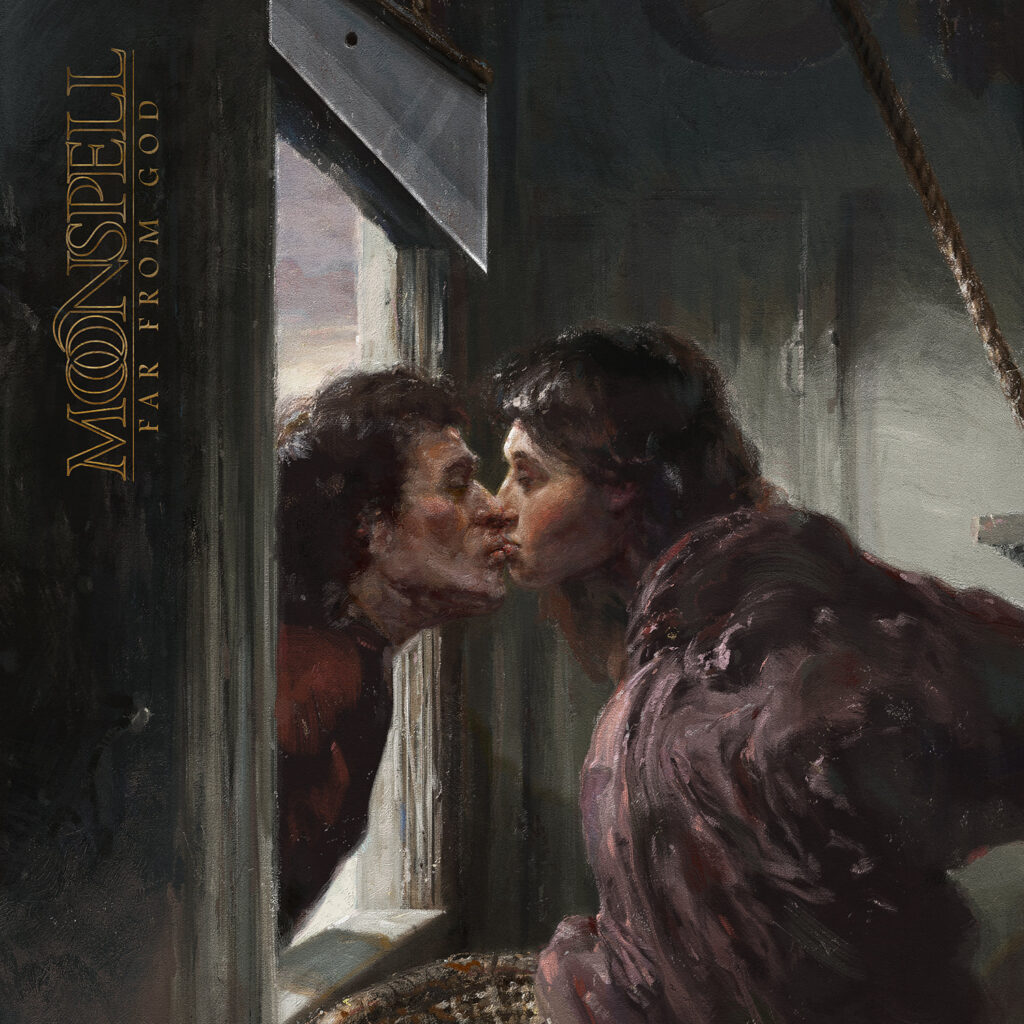
To understand what Far From God accomplishes, it helps to trace the arc that led here. The Portuguese institution built its legend on the gothic black metal of Wolfheart (1995) and the definitive Irreligious (1996) — records that established the atmospheric, dark romantic strain of European heavy music for a generation. What followed were decades of restless reinvention: industrial detours on Sin/Pecado, orchestral expansions through Night Eternal and 1755, and the progressive textures of 2021’s Hermitage. That last record, received with measured enthusiasm, represented a first step back from the symphonic weight that had come to define Moonspell‘s recent output. Far From God completes the retreat. The orchestration is gone. The arrangements breathe.
The decision to work with producer Jaime Gomez Arellano — whose résumé runs through Paradise Lost, Sólstafir, and Ghost — is not incidental. This is a man who understands the value of negative space in heavy music, and his fingerprints are audible throughout. The album’s sonic character is warm, dark, and analog-feeling, less layered than anything Moonspell has released in years, meaning every element has room to register on its own terms. Aires Pereira’s bass is an unexpected standout: it sits unusually high in the mix for a gothic metal record, and on “Biblical” its presence anchors a track that might otherwise drift on the strength of its romance alone. Pedro Paixão’s keyboards function not as decoration but as structural atmosphere — subterranean, constant, load-bearing. The guitars carry emotional depth rather than riff weight. Ribeiro’s baritone cleans sit exactly where they should: forward, legible, unobstructed by the orchestral density of recent records.
The thematic architecture of Far From God rests on a single philosophical premise that Moonspell have always circled but rarely stated this plainly: to love fully, to inhabit darkness completely, is to be estranged from the divine — and that estrangement is not lamented but chosen. The title track, the album’s lead single and most crystalline statement of purpose, delivers the thesis in a single lyrical image: “Far from god but close to you I feel / Full of life: on your love, on your blood / I feed tonight.” Spiritual exile and erotic hunger collapse into the same act. This is Baudelaire’s territory — beauty inseparable from damnation — and Moonspell execute it without irony and without camp. Elsewhere, “Biblical” stages the Fall as a love story in miniature (“We were the first to summon sin / Under the tree we found our meaning”), while “Reconquista” closes the record with a volta into Portuguese — Em ti me encontro — reconquista (“In you I find myself — reconquest”) — that reframes the album’s long meditation on spiritual exile as a form of self-recovery. Vampires and werewolves are the mythological vehicles throughout, but they never function as genre decoration; they carry genuine weight, grief, and longing.
The promo materials reach for the obvious comparison: the “Irreligious of the 21st century.” That framing deserves skepticism. Far From God is an excellent record on its own terms, which is precisely why it doesn’t require the comparison — and won’t survive it. What the album shares with Irreligious is a commitment to atmospheric restraint and dark romanticism over maximalist arrangement. What it doesn’t share is the shock of novelty. This is Moonspell at their most clear-eyed, not their most revelatory, and those are different achievements worth distinguishing.
Album opener “Cross Your Heart” is the most immediate and arguably the finest of the eight tracks: a post-punk-structured piece draped in gothic atmosphere that meditates on roadside memorial shrines and lives ended before their time. The grief is rendered without exploitation, the imagery of crosses and flowers along the road carrying genuine weight rather than genre-approved morbidity. “The Great Wolf in the Sky,” featuring string arranger Alicia Nuhro in what proves to be a genuinely load-bearing guest role, is the album’s most expansive moment — simultaneously a tribute to wolves who traveled with the band and an elegy for a fan and friend who didn’t live to hear this record. The multilingual wolf litany — lobo, lupus, wolf, ulv, likos, varg — signals something ancient and universal rather than regionally specific, and it earns the moment it occupies.
The back half requires a more qualified reading. “Our Freedom to Fall” pivots into Type O Negative-adjacent chugging and marks the first full deployment of harsh vocals — a satisfying release of tension, and lyrically the album’s most viscerally direct moment (“In the heart of fire, in your ashes of white / Our freedom to fall and again feel alive”). But it also signals the point where the album’s tonal identity begins to strain. The harsh vocals accumulate across the closing tracks to an extent that quietly undermines the restraint that made the first five tracks so effective. “Reconquista,” ambitious in its closing Portuguese-language pivot, is six minutes of a composition that doesn’t quite command six minutes; the song wanders in its middle third before arriving at a keyboard fade that feels more like an exit than a resolution.
These are genuine structural considerations, not minor quibbles. The honest shape of the record is exceptional, opening with a strong exploratory body and slightly uneven landing. That said, the creative decision at the center of this album — to strip away the accumulated orchestral density and trust the core of the sound — is the right one, and it pays off more often than not.
Moonspell do not need to chase relevance. Far From God is the most persuasive argument they’ve made for that position in years. “After three and a half decades, Moonspell still know exactly who they are — and on Far From God, that turns out to be enough.”
Far From God Tracklist:
- Cross Your Heart
- Far From God
- Biblical
- The Great Wolf in the Sky (ft. Alicia Nuhro on strings)
- Your Promise of Light
- For the Love of Mortals
- Our Freedom to Fall
- Reconquista
MOONSPELL Live Dates 2026:
- 20.06.2026 (BE) Dessel – Graspop Metal Meeting
- 10.07.2026 (FI) Kotka – Dark River Festival
- 16.07.2026 (PL) Bolków – Castle Party Festival
- 02.08.2026 (BU) Plovdiv – Ancient Theatre of Plovdiv (Opus Diabolicum Orchestra Show)
- 06.08.2026 (DE) Schlotheim – Party.San Metal Open Air
- 28.08.2026 (RO) Câmpulung Muscel – Posada Rock Festival
- 18.09.2026 (UK) London – Cosmic Void Festival
- 19.09.2026 (TR) Istanbul – Bosphorus Open Air Metal Fest
For More Info Visit:
- Website | https://www.moonspell.com
- Facebook | https://www.facebook.com/moonspellband
- Instagram | https://www.instagram.com/moonspellofficial
- Youtube | https://www.youtube.com/user/MoonspellYT
- Spotify | https://open.spotify.com/artist/17bYSQ9ZRnreVnJjE5X2x6
- Napalm Records | https://label.napalmrecords.com/moonspell
MOONSPELL is:
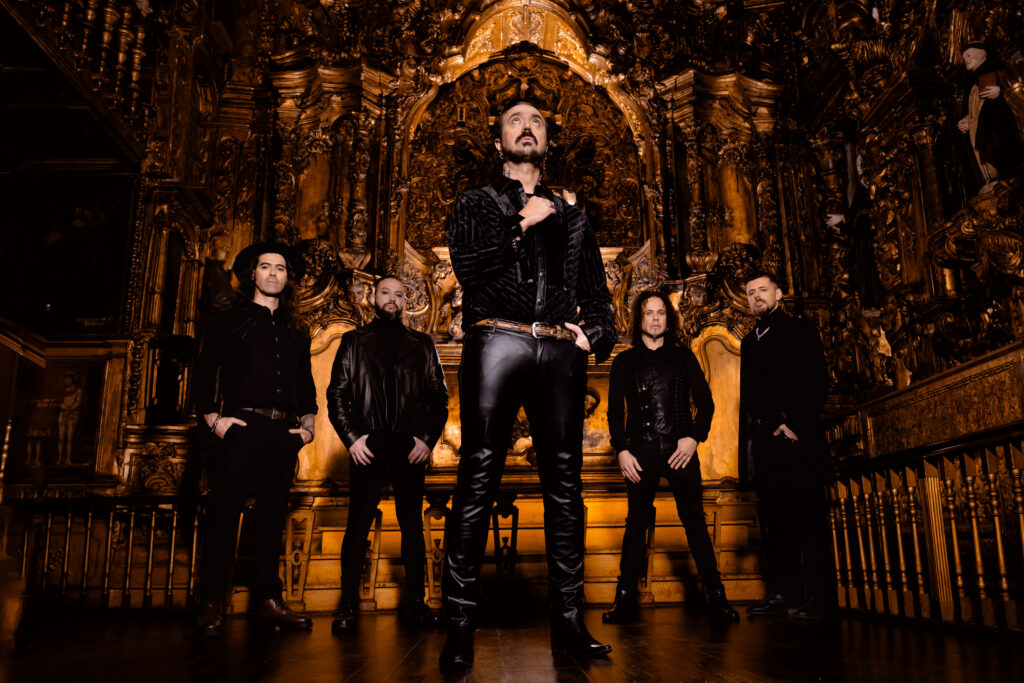
- Fernando Ribeiro – Vocals
- Ricardo Amorim – Guitars
- Pedro Paixão – Keys
- Aires Pereira – Bass
- Hugo Ribeiro – Drums
Review
Overall - 8
8
After five years and a deliberate retreat from orchestral density, Moonspell's thirteenth studio album arrives as one of the most compositionally focused statements of their career — produced by Jaime Gomez Arellano with a philosophy of restraint that gives Ribeiro's baritone cleans, Pereira's prominent bass, and Paixão's structural keyboards room to register as a unified, atmospheric whole. Thematically built around the Baudelairian premise that to love completely is to be estranged from the divine — vampires and werewolves as genuine emotional vehicles rather than gothic wallpaper — Far From God is front-loaded with some of the finest songwriting Moonspell have committed to record in decades, even if the back half tests the album's tonal coherence as the harsh vocals accumulate and "Reconquista" asks more structural patience than its six minutes fully deliver. Moonspell do not need to chase relevance — Far From God is proof they never did.